
WHY CATHOLICS MUST NOT ATTEND THE NEW MASS!
Introduction: A Question of Faith, Not Preference
The question of attending the New Mass (Novus Ordo Missae) is not a matter of taste, aesthetics, or personal spirituality. It is a theological and moral question that touches the very heart of Catholic faith: the nature of the Holy Sacrifice of the Mass, the Church’s infallible Magisterium, and the duty of Catholics to preserve the faith intact.
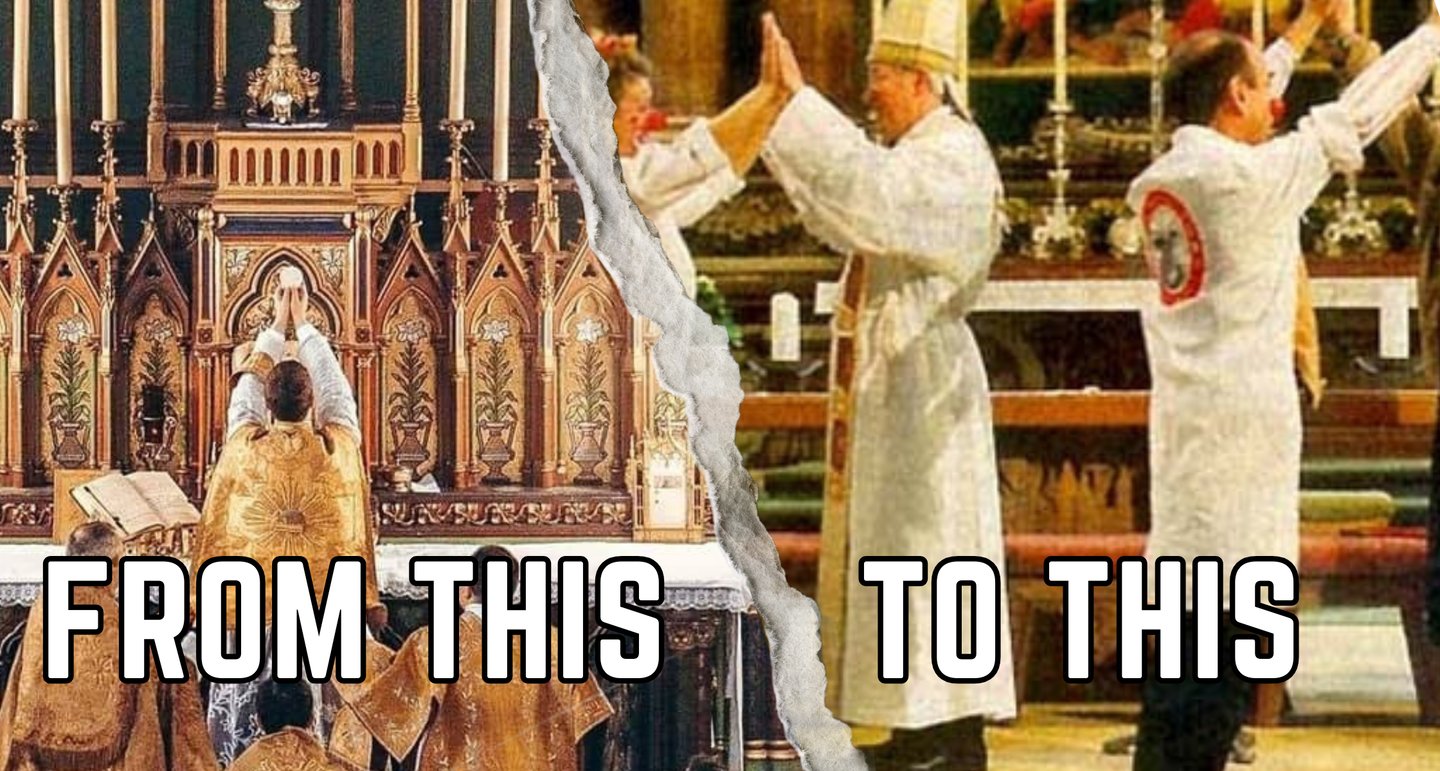
Drawing from Father Anthony Cekada’s Work of Human Hands, traditional Catholic theology, and authoritative papal teaching, this article explains why Catholics must not attend the New Mass.
For those who are unaware, the New Mass is a new form of worship introduced to the world by anti-Pope Paul VI shortly after Vatican II. It is particularly evident that Paul VI was not a true pope since in Quo Primum, Pope St. Pius V explicitly forbade the alteration or replacement of the Roman Mass, commanded its use in perpetuity, declared that no one may be forced to abandon it, and condemned the idea that one could even attempt to introduce another rite without "incuring the wrath of Almighty God and of the Blessed Apostles Peter and Paul.”
Not only are Catholics not free to participate in rites that undermine or obscure dogma, but it is wrong even to assert that from the Church itself practices that obscure doctrine can be introduced to the true mass, far less for an entire novel rite. So even if such evil or deficient rites are presented by what seems to be ecclesiastical authority one must not attend.
Pope Pius XII explicitly taught that "it is not right to introduce novel liturgical practices which obscure Catholic doctrine.” ( Mediator Dei, §§62–63). Before Pius XII, Pope Pius VI in Auctorem Fidei Dogmatically taught that "The proposition which asserts that the Church has the right to establish or approve disciplines that are dangerous, harmful, or conducive to superstition and materialism is false, rash, and injurious to the Church.” (Auctorem Fidei, Denzinger 1578).
When we look upon the Novus Ordo Rite of worship we see a Rite that in no way clearly expresses Catholic doctrine. Catholics must then refuse cooperation with this rite since it cannot come from the Catholic church.
I. The Mass Is a Dogmatic Act of the Church
Unlike the protestant notion of church services or "worship," the Catholic Mass is an authentic sacrificial and dogmatic act. The Church teaches infallibly through her liturgy, because lex orandi, lex credendi—the law of prayer is the law of belief.
Pope Pius VI condemned the idea that the Church’s rites could be altered without doctrinal consequences: The proposition which declares that the ceremonies, vestments, and rites of the Church are not necessary for preserving doctrine, or that they may be changed without danger to faith, is false, rash, scandalous, and injurious to pious ears.”
— Auctorem Fidei, DH 1536–1537
The Council of Trent solemnly taught that the rite of the Mass is protected by the Church so that nothing false or dangerous to faith may be introduced.
Therefore:
• A Catholic rite must clearly and unequivocally express Catholic dogma.
• Any rite that weakens or obscures Catholic dogmas is objectively harmful, regardless of the minister’s intentions.
The New Mass fails this test.
II. The New Mass Was Constructed, Not Received
Father Cekada demonstrates that the New Mass is not an organic development of the Roman Rite but a manufactured product, assembled by a committee and promulgated as a replacement for a rite that had been canonized by centuries of use.
Unlike the Catholic Mass, which is an Apostolic Rite that developed organically under the guidance of the Holy Ghost, the New Mass was:
• Composed by a commission (the Consilium)
• Influenced by Protestant observers
• Designed to remove or "soften" elements offensive to non-Catholics
This alone marks a radical rupture with Catholic tradition. Pope St. Pius V, in Quo Primum, codified the Roman Mass precisely to protect it from doctrinal corruption. The New Mass does the opposite.
III. The Offertory: From Sacrifice to Supper
One of Father Cekada’s strongest arguments concerns the Offertory prayers.
In the Catholic Mass, the Offertory explicitly speaks of:
• A propitiatory sacrifice
• Sin, atonement, and satisfaction
• The priest offering the victim to God
In the New Mass, these prayers were replaced with Jewish-style table blessings (some of which come from the demonic Jewish Talmud) that speak only of:
• Bread and wine as gifts of the earth
• Human labor (“work of human hands”)
The sacrificial language is removed.
This is not accidental. As Father Cekada shows, the new Offertory was deliberately crafted to avoid any clear reference to a propitiatory sacrifice, aligning it more closely with Protestant theology.
A Mass that obscures sacrifice attacks the very essence of the Mass itself.
IV. A Rite That Can Be Understood Protestantly Is Defective
Catholic theology has always held that a valid Catholic rite must be unambiguously Catholic. One need not be a theological expert to know this truth, the Catholic mass is Catholic.
The New Mass was intentionally designed so that Protestants could accept it without violating their beliefs. The New Mass then is designed specifically not to be expressedly Catholic. This is documented fact, not speculation. Calvinist pastor (and official "observer" to the Consilium) Max Thurian (Taizé) said, “One of the great achievements of the new liturgy is that it is now possible for Protestants to use the same prayers as Catholics without betraying their theology” (Max Thurian, La Croix, May 30, 1969). It is clear then that the New Mass shares a theological unity with such protestants.
But Pope Pius XI condemned religious compromise in Mortalium Animos, teaching that Catholic worship cannot be reshaped to accommodate heresy. A rite that can be interpreted as:
• A mere memorial meal
• A community gathering
• A symbolic action is not safe for Catholic faith, even if it can also be interpreted in an orthodox sense.
Ambiguity in matters of faith is poison.
"If anyone says that the Sacrifice of the Mass is only a sacrifice of praise and thanksgiving, or a bare
commemoration of the sacrifice consummated on the Cross… let him be anathema.” (Trent, Session XXII, Canon 3)
V. The Priesthood Is Minimized, the Assembly Exalted
In Catholic theology, the priest acts in persona Christi, offering the Sacrifice on behalf of the faithful. While laymen have an obligation to attend mass on certain days, and should even aim yo attend mass frequently, they are not an essential element for the mass itself. The mass can occur just the same without the faithful since they play no active role in the Sacrifice offered at the mass.
The Catholic Church teaches that, "“They err from the path of truth who hold that the people, by their presence, offer the Sacrifice together with the priest.” (Mediator Dei, §92 )
The New Mass deliberately shifts emphasis:
• From priest to “presider”
• From altar to table
• From sacrifice to assembly
This change is not superficial. It reflects a new theology of worship in which the congregation becomes the focus rather than the sacrificial action of Christ through His priest.
Pope Pius XII explicitly warned against such errors in Mediator Dei, condemning attempts to reduce the priest’s unique sacrificial role.
VI. Participation in a Harmful Rite Is Morally Unlawful
Catholic moral theology teaches that one may not actively participate in a rite that:
• Endangers faith
• Gives scandal
• Implicitly endorses error
Attendance at the New Mass constitutes active religious participation, not passive observation. Even if one personally holds orthodox beliefs, participation signals acceptance of the rite as Catholic.
Catholics cannot attend the New Mass simply because it is not the Catholic Mass. The Catholic Roman Rite is traceable to the Apostolic times while the New Mass is just that: New! (Different).
VII: The Papal Throne is vacant: Theological Principles That Admit No Exception
A. The Infallibility of the Church’s Universal Discipline
Catholic theology teaches that the universal disciplinary laws of the Church are infallibly safe. This principle is taught unanimously by approved theologians and is rooted in Christ’s promises to His Church.
St. Robert Bellarmine teaches:
“The Church cannot err in prescribing a discipline that is harmful to souls or contrary to faith or morals.”
Likewise, Suarez, Billot, and Van Noort teach that universal liturgical laws are protected by infallibility precisely because the faithful are morally obliged to follow them.
Therefore the principle is absolute:
• If a rite is promulgated universally, it must be safe.
• If a rite is harmful to faith, it cannot be from the true Church.
There is no third option.
B. The New Mass Is Harmful to Faith — A Demonstrable Fact
As already shown:
• It obscures the dogma of the propitiatory sacrifice
• It was designed to be acceptable to Protestants
• It systematically removes sacrificial and priestly language
• It introduces doctrinal ambiguity where Trent demanded clarity
These are objective facts, admitted even by its architects.
Therefore, by Catholic theological necessity, the New Mass cannot be a universal law of the Catholic Church.
C. The Logical Consequence: The Authority Promulgating It Cannot Be Catholic
If the Church is indefectible, and if the New Mass is doctrinally defective, then the authority that promulgated it cannot possess the authority of the Catholic Church.
This is not an emotional conclusion. It is a theological syllogism:
• The Catholic Church cannot promulgate a harmful or heretical rite.
• The New Mass is a harmful and doctrinally corrupt rite.
• Therefore, the New Mass does not come from the Catholic Church.
Consequently, those who promulgated it cannot be true popes or true Catholic authorities, since a true pope is infallibly protected from imposing such a rite on the universal Church.
Therefore, although majority of the world believes
Leo XIV to be a Pope the true conclusion is that he is not. This flows necessarily from Catholic dogma, not private judgment.
D. Vatican II as the Root of the Liturgical Apostasy
The New Mass is not an isolated abuse; it is the liturgical expression of Vatican II’s new ecclesiology:
• A false ecumenism condemned by Mortalium Animos
• A false notion of religious liberty condemned by Quanta Cura
• A false understanding of the Church as a “people of God” rather than a hierarchical society
The New Mass incarnates these errors ritually. As lex orandi shapes lex credendi, the New Mass inevitably produces a new religion or is the expression of such a religion.
E. Attendance at the New Mass Is Formal Cooperation in a False Religion
Catholic moral theology distinguishes between:
• Material cooperation (sometimes tolerated)
• Formal cooperation (always sinful)
Attendance at the New Mass is formal religious participation in a rite that expresses a non-Catholic theology of worship. Even passive attendance signifies adherence to the rite as Catholic.
St. Alphonsus Liguori teaches that one may never participate in non-Catholic worship, even externally, if it implies approval.
Therefore:
• Attendance at the New Mass is morally unlawful
• Habitual attendance endangers the virtue of faith
• Catholics must abstain, even at personal cost
F. The Church Has Endured Vacancies Before
A vacant See of Peter does not destroy the Church. History records interregnums lasting years, even decades. What cannot occur is the Church defecting from the faith.
Christ promised:
“I am with you all days, even to the consummation of the world.” (Matthew 28:20)
This promise excludes the possibility of a universally imposed false rite. It does not exclude a prolonged vacancy during an unprecedented crisis.
G. The Only Catholic Position Consistent With Dogma
Thus Catholics face a choice that admits no compromise:
• Either the New Mass is Catholic — and Trent, Quo Primum, and Mediator Dei are false
• Or Trent, the perennial Magisterium, and the indefectibility of the Church are true — and the New Mass is a counterfeit
There is no middle ground.
Holding the Sedevacantist position is not radical. Modernism is radical. Sedevacantism simply refuses to attribute error to the Church of Christ.
Fidelity to Christ Requires Separation from Error
The crisis of the New Mass is not merely a crisis of liturgy; it is a crisis of faith, authority, and truth. Catholics are not permitted to suspend the principles of Catholic theology in order to preserve external unity or personal comfort. When a rite of worship no longer clearly professes the Catholic faith, fidelity to Christ demands separation from that rite, no matter how widely accepted it may be.
The Church of Christ is indefectible. She cannot impose upon the faithful a rite that undermines dogma, obscures the Sacrifice of Calvary, minimizes the priesthood, and accommodates heresy. To claim otherwise is to deny the promises of Christ, the infallibility of the Church’s universal discipline, and the consistent teaching of the Roman Pontiffs before Vatican II.
Therefore, Catholics must not attend the New Mass—not out of pride, nostalgia, or personal preference, but out of obedience to the Catholic faith as it has always been taught. To refuse the New Mass is not to abandon the Church; it is to cling to her. To reject a counterfeit rite is not schism; it is fidelity. To hold fast to the Mass of all ages is not extremism; it is Catholicism.
In an age of unprecedented confusion, the duty of Catholics is clear: to remain with what the Church has always believed, always taught, and always worshiped, even if that fidelity comes at the cost of isolation, misunderstanding, or persecution. Truth does not change, the Sacrifice of Christ does not change, and the Church founded by Christ cannot contradict herself.
When the smoke of confusion clears, it will not be those who compromised who are vindicated, but those who held fast.
Non possumus. We cannot do otherwise!
Contact
Phone
info@mostholytrinity.org
© 2026. All rights reserved.