
THE HOLY INNOCENTS
Taken From THE LITURGICAL YEAR, Dom Guéranger OSB, | Christmas
The Feast of the Holy Innocents
The Holy Innocents at the Crib
THE feast of the beloved Disciple is followed by that of the Holy Innocents. The Crib of Jesus—where we have already met and venerated the Prince of Martyrs and the Eagle of Patmos—has to-day standing round it a lovely choir of little Children, clad in snowwhite robes, and holding green branches in their hands.
The Divine Babe smiles upon them—he is their King; and these Innocents are smiling upon the Church of God. Courage and Fidelity first led us to the Crib; Innocence now comes, and bids us tarry there.
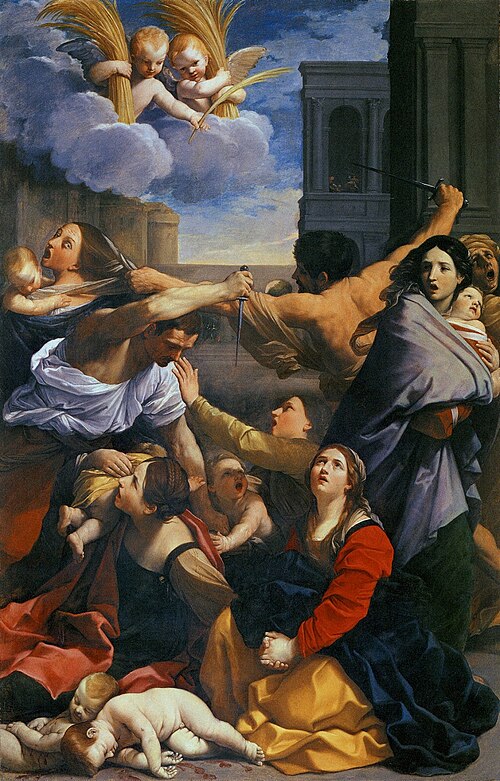
Herod’s Cruel Design and God’s Triumph
Herod intended to include the Son of God amongst the murdered Babes of Bethlehem. The Daughters of Rachel wept over their little ones, and the land streamed with blood; but, the Tyrant's policy can do no more:—it cannot reach Jesus, and its whole plot ends in recruiting an immense army of Martyrs for heaven.
These Children were not capable of knowing what an honour it was for them, to be made victims for the sake of the Saviour of the world; but, the very first instant after their immolation, and all was revealed to them: they had gone through this world without knowing it, and now that they know it, they possess an infinitely better.
The Mercy of God and the Martyrdom of the Innocents
God showed here the riches of his mercy—he asks of them but a momentary suffering, and that over, they wake up in Abraham's Bosom: no further trial awaits them, they are in spotless innocence, and the glory due to a soldier who died to save the life of his Prince, belongs eternally to them.
They died for Jesus' sake—therefore, their death was a real Martyrdom, and the Church calls them by the beautiful name of The Flowers of the Martyrs, because of their tender age and their innocence.
The Place of the Holy Innocents in the Liturgical Cycle
Justly, then, does the ecclesiastical Cycle bring them before us to-day, immediately after the two valiant Champions of Christ, Saint Stephen and Saint John.
The connection of these three Feasts is thus admirably explained by St. Bernard:
"In St. Stephen, we have
both the act and the desire of Martyrdom; in St.
John, we have but the desire; in the Holy Inno-
cents, we have but the act.
Will any one
doubt whether a crown was given to these Inno-
cents?
If you ask me what merit could
they have that God should crown them? let me
ask you, what was the fault, for which Herod slew
them?
What! is the mercy of Jesus less than the
cruelty of Herod?
…
From the mouth of the Infants and the Sucklings
thou hast perfected praise.
…
till He cometh who will say:
‘Suffer Little
Children to come unto me, for of such is the
kingdom of heaven…’
(Sermon for the Feast of the Holy Innocents.)
Baptised in Blood
Yes, God did for these Innocents, who were immolated on his Son's account, what he is doing every moment now by the sacrament of regeneration, in the case of children, who die before coming to the use of reason.
We, who have been baptised by water, should be all the more ready to honour these Little Ones, who were baptised in their own blood, and thereby associated to all the mysteries of the Divine Infancy.
The Lambs with the Lamb of God
We ought, together with the Church, to congratulate them, for that a glorious and premature death secured them their innocence. They have lived upon our earth, and yet it defiled them not! Truly, these tender Lambs deserve to be for ever with the Lamb of God!
May this same earth of ours, grown old in wickedness, draw down the divine mercy on itself, by the love and honour it gives, each year, to these sweet Children of Bethlehem, who, like the Dove of Noah's Ark, could not find whereon to rest their feet.
The Church’s Mourning and Delicate Reverence
In the midst of the joy, which, at this holy time, fills both heaven and earth, the Holy Church of Rome forgets not the lamentations of the Mothers, who beheld their Children cruelly butchered by Herod's soldiers.
She hears the wailing of Rachel, and condoles with her; and, unless it be a Sunday, she suspends on this Feast some of the manifestations of the joy, which inundates her soul during the Octave of her Jesus' Birth.
The Red vestments of a Martyr's Day would be too expressive of that stream of infant blood which forbids the Mothers to be comforted, and joyous White would ill suit their poignant grief; she, therefore vests in Purple, the symbol of mournfulness.¹
The Gloria in excelsis, the Hymn she loves so passionately during these days, when Angels come down from heaven to sing it—even that must be hushed to-day: and, in the Holy Sacrifice, she sings no Alleluia.
In this, as in everything she does, the Church acts with an exquisite delicacy of feeling. Her Liturgy is a school of refined christian considerateness.
Joy Amidst Sorrow
This expression of sympathy gives to-day's Office a pathetic sadness, which, however, in no ways interferes with the joy, which the Church feels in celebrating the Feast of the Holy Innocents.
She keeps it with an Octave, as she does the two preceding Feasts of St. Stephen and St. John.
Children Honoured in the Liturgy
She sanctions the practice, observed in Cathedrals and Collegiate Churches, of allowing young boys to share in the duties of the Choir, and blend their innocent chanting with that of the Ministers of God.
She grants them several privileges, and takes pleasure in seeing the delight wherewith these children perform the several functions entrusted to them.
This joy, this simplicity, this innocence, all add a charm to the divine Service; and through these youthful Choristers, the Church pays honour to the Infant Jesus, and to the Holy Innocents of Bethlehem.
Stations of the Feast in Rome
In Rome, the Station for the Feast of St. Stephen is in the Church dedicated to the holy Protomartyr, on Monte Celio; that for St. John is in the Basilica of St. Mary Major; to-day, the Station is made at St. Paul's Beyond the Walls, which possesses several of the bodies of the Holy Innocents.
In the 16th century, Pope Xystus the Fifth caused a portion of these Relics to be translated to St. Mary Major's, and Lut near the holy Relic of our Lord's Crib.
Related Articles: Saints Page
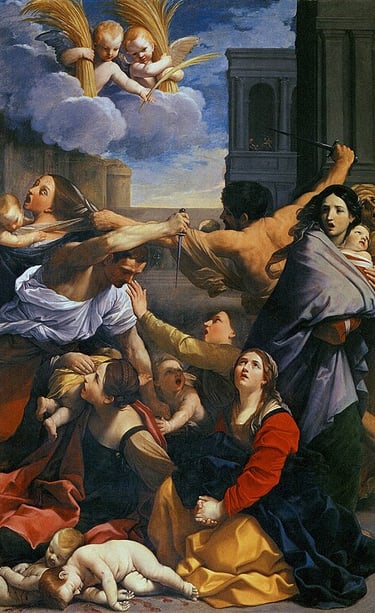
Guido_Reni_-_Massacre_of_the_Innocents (1611)
Contact
Phone
info@mostholytrinity.org
© 2026. All rights reserved.