
The Feast of Our Lady of Guadalupe
Adapted from the 1945 Roman Missal and Excerpts Based on Various Guadalupe Handbooks
by Pauly Fongemie
PREFACE
The Liturgical Year does not include the Feast of Our Lady of Guadalupe because this Feast is not celebrated universally, but in Mexico, Spain, and the United States, the date for the latter being December 12. So I have taken the orations, etc. from the 1945 Roman Missal, Fr. Lasance version.
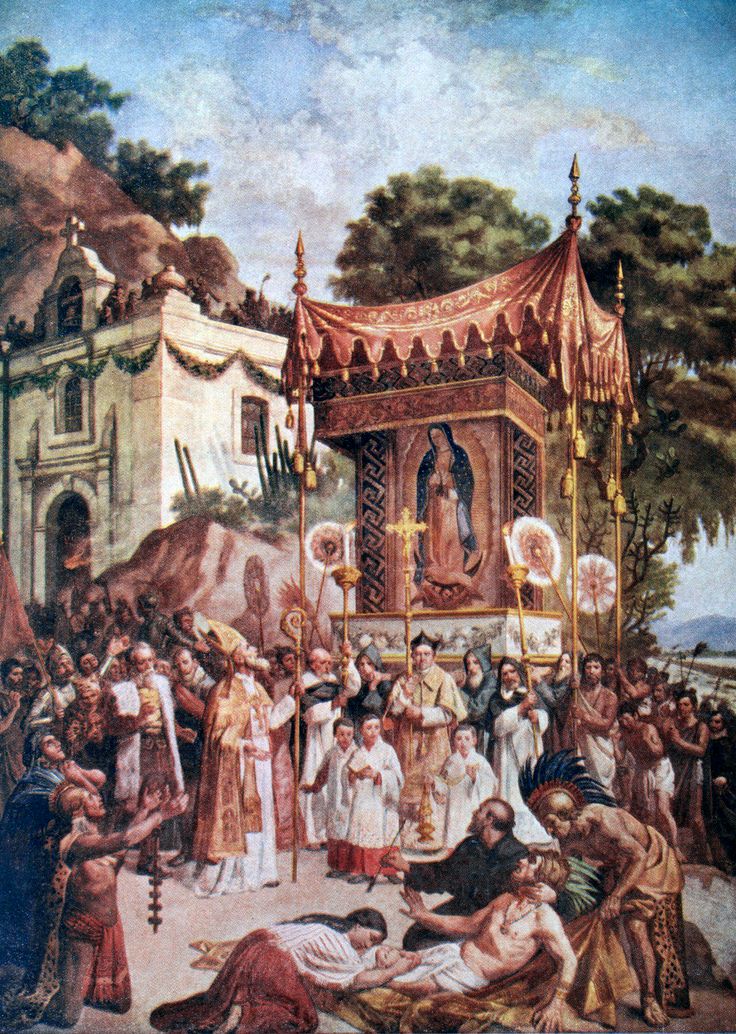
OUR LADY OF GUADALUPE: A LITTLE DISCOURSE
Nothing is accidental with God, so it is not mere coincidence that the Feast of Our Lady of Guadalupe, which falls on December 12 in the United States, is within the Octave of the Feast of The Immaculate Conception, December 8 and following. In both appearances-----at Lourdes, France in 1858 and on Tepeyac Hill in Mexico in 1531-----she appeared to a lone seer, each one being very poor and most pure, and said "I am" and gave her name in reference to each apparition: "I am the Immaculate Conception" and " I am your Mother."
In the first apparition the healing that followed was spiritual-----that of conversion from barbarism to the sweetness of Catholicism; in the second, physical cures as well as conversions. But the significance of the titles she gave includes the close connection between two apparitions that were 327 years apart. In both Mary's Motherhood is proclaimed. At Guadalupe she came as "Mother", Mother of the poor, the Mother of Sorrows and the Mother of God, as depicted in her garments which to the Indian natives of Mexico were evidence of her approaching time at Bethlehem. At Lourdes, Mary's Divine maternity is enshrined in her Immaculate Conception, God's great work and miracle, the Mother of God and of the Church, who was conceived without Original Sin, who bears the Savior of Mankind. The name Guadalupe, is roughly translated as the "savior from the devil." In truth both apparitions are Apocalyptic, for Our Lady is the Woman with the Twelve Stars who will crush the seed of Satan.
From the time of the appearance of the Miraculous Image on the tilma of St. Juan Diego, Catholics, both Spaniard and Indian, Americans and Europeans, have believed that there is a relationship between the Immaculate Conception and Guadalupe. Although the dogma of the Immaculate Conception was declared centuries after Guadalupe, as with the dogma of the Assumption, its belief was intrinsically held by the faithful since the beginning of the Church. And the same with the Immaculate Conception.
For two hundred years after the apparition at Guadalupe on Tepeyac Hill this connection was evident by the discussions of the "Woman clothed with the sun" in Apocalypse 12, 1 and following, and its likeness to the Miraculous Figure of the Mother of God on the tilma. By the time of Guadalupe, it was already commonplace among Catholics to identify the Woman of the Apocalypse with the Immaculate Conception.
In more recent times it has been noted that the words Our Lady used to identify herself to Juan Diego, "Quetzalcoatl", that is, I am the one who has crushed the head of the serpent. To the Spanish ear, the name transliterated into Guadalupe, the name of a popular shrine in Spain.
And thus this version became the popularized title for our Lady in Mexico, not just Spain. But if one thinks that the mere similar pronunciation of the two words provides the actual link between the Virgin of Guadalupe in Spain and Our Lady of Guadalupe in Mexico and the Immaculate Conception, then one is mistaken, for that similarity is but a signpost: I cite from A HANDBOOK ON GUADALUPE by the Franciscan Friars of the Immaculate, pp. 160-161:
By the end of the 15th century the Franciscans had placed in the shrine of Our Lady of Guadalupe in Extremadura, Spain, a statue of the Immaculate Conception, one which soon became a popular object of veneration. There is also good evidence that the same statue had already been made known by the Franciscan missionaries in Mexico to the Indians and that perhaps a reproduction was already venerated in the vicinity of Tepeyac.
Now, the similarity between the depiction of the Immaculate in the statue placed by the Friars Minor in the sanctuary of Extremadura and the Image on the tilma is extraordinarily close, so close that anyone from the region of Extremadura, like the Spanish translator in the Bishop's palace, hearing what sounded like Guadalupe, would have spontaneously associated this Image with the Immaculate Conception statue in Spain. [We regret to say that we have no image of this shrine-----the web Master.]
In the Franciscan tradition the Immaculate is Our Lady, Queen of the Angels, whose Portiuncula (Little Portion) was the chapel where Angels were often seen to descend and ascend, waiting on their Queen and her clients, "the rest of her offspring," i.e., the rest of the Savior's brethren (cf. Apoc. 12: 17). This is the place where St. Francis came to understand his vocation, found his Order and where he died.
When, therefore, the good Bishop beheld the roses spilling on the floor, it was not only a sign that he could believe Juan Diego, but an answer to his own prayer for a sign assuring the success of the evangelization and the pacification of the two peoples. When he saw the image of Our Lady supported by an Angel at her feet on the tilma, he could not help but recognize the Franciscan mode of conceiving the Immaculate as Queen of the Angels. The link between Guadalupe in Mexico, Guadalupe in Spain and the Immaculate Conception was fixed. The core of the Perfect Virgin's message at every authenticated appearance since, because she is the Immaculate, rests upon her maternal mediation as Dispenstrix of God's mercy and grace. It is she upon whom the Angels wait, the Angels venerated at both Guadalupe shrines.
Now, let us look at Our Lady of Guadalupe as this is the Feast we celebrate here:
Against every oppressor, against every persecutor, Our Lady stands: Maria Morena, the Dark Virgin, gentle, loving, invulnerable, inextinguishably shining. Neither narrow-minded later Spaniards who disapproved of her too common associations (there has always been a certain type of Christian who tends to find Mary very undignified) nor anti-Catholic fanatics who saw the Church as the supreme obstacle to what they called "progress", dared for centuries to touch her. But they could not forget that she was there. Finally, in perhaps the greatest crisis in Mexican history after the conquest itself, when the revolutionary constitution of 1917 (the year Mary appeared at Fatima) had turned over full control of the Church in Mexico to the bitterly anti-Catholic government of Obregon and Calles, the Church's enemies struck at Our Lady of Guadalupe directly. A bomb was concealed in a bouquet of flowers placed under her sacred image on November 14, 1921. It exploded during Mass. Pieces of stone were ripped from the sanctuary; the force of the explosion twisted a heavy metal cross on the altar into an almost circular shape. But not one worshipper in the packed church was hurt; and the sacred image was absolutely untouched.
A chapel of reparation was later added to the church of Our Lady of Guadalupe, with the twisted cross placed in it to remind the faithful of the evil that had struck and the protection that had been given. The symbolism was also profound. For it is the Cross that good Christians must bear, the Cross that represents both the power of the forces of destruction and the means of redemption; but the Mother of God is forever safe. and her portrait belongs to the Catholic people of Mexico and will not be taken from them.
Mexico's faith survived Obregon and Calles, as it had survived all its enemies before them. In recent years the Mexican government has become less hostile to the Faith. Millions greeted Pope John Paul II when, on January 27, 1979, he became the first Pope to visit the shrine of Our Lady of Guadalupe and to behold directly the portrait of the Mother of God . . . But Our Lady of Guadalupe is not only the "Happiness of Mexico." Every well authenticated personal appearance of the Mother of God in history is immensely significant to the whole world. No more than it could be a coincidence that there were five million Indian baptisms in Mexico in the first five years after she appeared on the hill of Tepeyac, can it be a coincidence that those five same years, 1532-1536, were the years that England left the Catholic Church. In April 1532, just five months after the apparition, the clergy of England formally submitted to the authority of Henry VIII, who was demanding an annulment of his marriage to Catherine of Aragon-----Queen Isabel's youngest daughter-----which Pope Clement VII had refused, on the best of grounds, to grant. The next month St. Thomas More resigned as Chancellor of England because his king was moving into rebellion against the Church Christ founded. In May 1533 Thomas Cranmer, Henry VIII's choice as Archbishop of Canterbury (the highest ecclesiastical office in England), recognized Henry's marriage to Anne Boleyn, and in July Pope Clement excommunicated the King of England. In March 1534 Parliament declared the final severance of the Church of England from the Roman Catholic Church, and ordered all its members, clergymen, and public officials to take an oath recognizing the legitimacy of the king's marriage despite the declaration of the Pope. St. Thomas More refused to take this oath. In November 1534 Parliament passed the Act of Supremacy making Henry VIII supreme head of the Church in England. The clergy were required to take an oath accepting that as well; only one bishop, St. John Fisher, refused. He was martyred for it on June 22, 1535; St. Thomas More was martyred July 6, 1535. In April 1536 Parliament and king, prodded by the rapacious Thomas Cromwell, expropriated the land and all the property of every monastery in England.
The parallel is breathtakingly precise, diamond-clear. As the people of England went out of the Church Christ founded, the people of Mexico came into it. The consequences to the Church of the loss of England reverberate down the centuries; she has suffered few greater losses in the whole of the Christian era. The consequences to the Church of the conversion of the majority of the population of the New World who live south of the United States still lie mostly in the future. But no part of the world is more Catholic, and few equally so-----and that is, above all, the gift of the Virgin of Guadalupe.
OUR LADY OF GUADALUPE, Warren H. Carroll, Christendom Press, pp. 112-113.
Related Articles: Go to Marian Page
Contact
Phone
info@mostholytrinity.org
© 2026. All rights reserved.