
ST. RAYMUND OF PEGNAFORT, CONFESSOR
Taken From THE LITURGICAL YEAR, Dom Guéranger OSB, | Christmas Vol 3
The glorious choir of Martyrs, that stands round our Emmanuel, till the day of his Presentation in the Temple, opens its ranks, from time to time, to give admission to the Confessors, whom divine Providence has willed should grace the Cycle during this sacred season. The Martyrs surpass all the other Saints in number; but, still, the Confessors are well represented. After Hilary, Paul, Maurus, and Antony, comes Raymund of Pegnafort, one of the glories of the Order of St. Dominic and of the Church, in the 13th century.
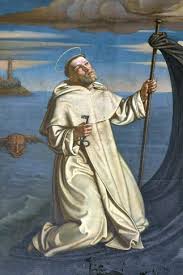
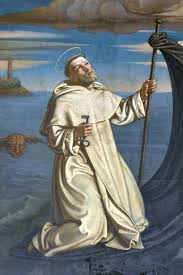
According to the saying of the Prophets, the Messias is come to be our Lawgiver; nay, he is himself our Law. His words are to be the rule of mankind; he will leave with his Church the power of legislation, to the end that she may guide men in holiness and justice, in all ages. As it is his Truth which resides over the teaching of the Faith, so is it his Wisdom that regulates Canonical Discipline. But the Church, in the administration of such power of her laws, engages the services of men, whom she judges to be the most competent for such work, by their knowledge of Canon Law and by the holiness of their lives.
St. Raymund has the honour of having been entrusted to draw up the Church’s Code of Canon Law. It was he who, in the year 1234, compiled, by order of Pope Gregory the Ninth, the five Books of the Decretals; and his name will ever be associated with this great work, which forms the basis of the actual discipline of the Church.
Raymund was a faithful disciple of that God, who came down from heaven to save sinners, by calling them to receive pardon. He has merited the beautiful title conferred on him by the Church, of excellent Minister of the Sacrament of Penance. He was the firm defender of blessed doctrine, and he was the doctrine, the maxims of christian morality, which regulated the duties of the confessor with regard to the faithful, whose souls are subject to the Stamp of Penitential Cases opened the series of those important Treatises, in which learned and holy men have carefully considered the claims of law and the obligations of man, in order to instruct the Priest how to pass judgment, as the Scripture says, between leprosy and leprosy.
In fine, when the glorious Mother of God, who is also the Mother of men, raised up, for the Redemption of Captives, the generous Peter Nolasco—whom we shall meet, a few days hence, at the Crib of our Redeemer—Raymund was an important instrument in this great work of mercy; and it is with good reason, that he is one of the Founders of Mercy looks upon him as one of the principal authors of their liberty.
Let us now read the account of the actions of this holy man, whose life was indeed a full one, and rich in merit. The Lessons of his Feast thus abridge his history.
Blessed Raymund was born at Barcelona, of the noble family of Pegnafort. Having been imbued with the rudiments of the christian faith, he afterwards gifted and had received, both of which he had begun quite a boy; he received to the degree of Doctor, and after his return to Barcelona, he gave himself up to the teaching of the science of law. He there acquired the best success, and was invited to teach that science in the Universities of Bologna and Paris. But he preferred remaining in his own country, and devoted himself to the direction of souls.
He was ordained Deacon, and afterwards Priest; and it was in the exercise of this ministry, that he displayed a zeal truly apostolic. His life was one of the strictest observance; he practised severe mortification; and his prayer was unceasing. He was remarkable for the humility with which he bore his great reputation. His charity knew no bounds; and he was always ready to relieve the necessities of the poor.
He was forty-five years of age, when he embraced the Order of Friars Preachers. He then, as a soldier, but just enlisted into service, devoted himself to the exercise of every virtue, both active and contemplative.
He assisted as confessor to Pope Gregory the Ninth, and was chosen Archbishop of Tarragona; which he refused, preferring the humble life of a Religious. He was sent to Barcelona, as Provincial of his Order; and he governed that Province with admirable prudence. He was indefatigable in preaching the Word of God; and his discourses were accompanied by a power which won over the most hardened hearts.
The Blessed Virgin appeared to him, one night, and said to him, that it would be expedient for the salvation of souls, that a Religious Order should be founded, whose mission it should be to deliver captives from the tyranny of infidels. Whereupon, after deliberating together, the fervent Nolasco, the generous Peter Nolasco, and St. Raymund drew up certain rules of life, which were approved by the Holy See; and thus was founded the Order of Mercy.
After some years, he obtained the permission of the Pope to resign the government of the Province, and he retired to Barcelona, to spend the remainder of his days in works of penance and prayer. He died in peace, on the 6th of January, in the year of our Lord 1275. He was canonized by Pope Clement the Eighth.
Related Articles: Saints Page
Contact
Phone
info@mostholytrinity.org
© 2026. All rights reserved.