
ST. PAUL, THE FIRST HERMIT.
Taken From THE LITURGICAL YEAR, Dom Guéranger OSB, | Christmas Vol 3
To-day, the Church honours the memory of one of those men, who were expressly chosen by God to represent the sublime detachment from all things, which was taught to the world by the example of the Son of God, born in a Cave, at Bethlehem. Paul the Hermit so prized the poverty of his Divine Master, that he fled to the desert, where he could find nothing to possess and nothing to covet. He had a mere cavern for his dwelling; a palm-tree provided him with food and clothing; fountains gave him wherewith to quench his thirst; and heaven sent him his only luxury, a loaf of bread brought to him daily by a raven. For sixty years, he lived thus, serenely in poverty, and in solitude, that God, who was denied a dwelling on the earth, he came to redeem, could have but a poor Stable wherein to be born.
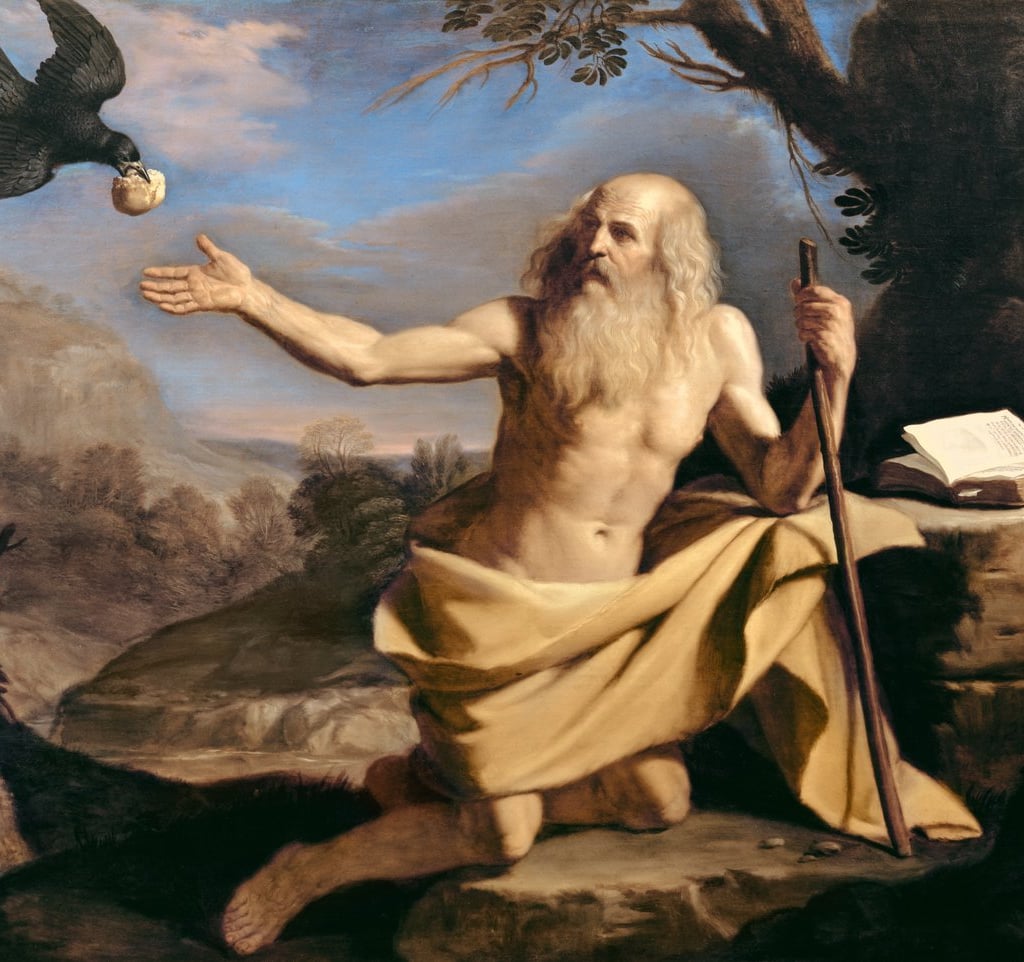
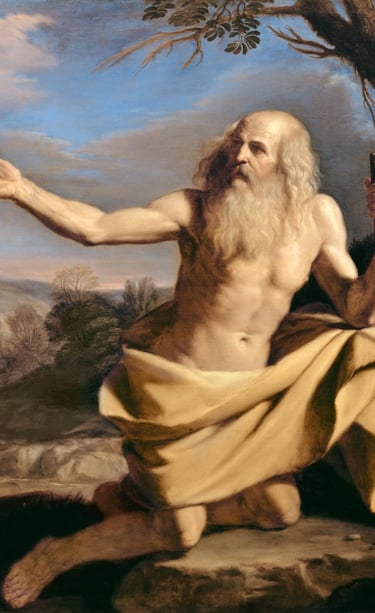
But God dwelt with Paul in his cavern; and in him began the Anchorites, that sublime race of men, who, the better to enjoy the company of their God, denied themselves, not only the society, but the very sight, of men. They were the Angels of earth, in whom God showed forth, for the instruction of the rest of men, that he is powerful enough, and rich enough, to supply the wants of his creatures, who, indeed, have nothing but what they have from Him.
The Hermit, or Anchorite, is a prodigy in the Church, and it behoves us to glorify the God who has produced it. We ought to be filled with astonishment and gratitude, as seeing how the Mystery of a God made Flesh has so elevated our human nature, as to inspire a contempt and abandonment of those earthly goods, which heretofore had been so eagerly sought after.
The two names, Paul and Antony, are not to be separated; they are the two Apostles of the Desert; both are Fathers—Paul of Anchore, and Antony of Cœnobites; the two families are sisters, and both have the same source, the Mystery of Bethlehem. The sacred Cycle of the Church has year after year faithfully done its justice to each of these two faithful disciples of Jesus in his Crib.
In Church readings her Office, the following abridgment of St. Paul’s wonderful Life.
Paulus, Eremitarum antiquissimus, apud inferiorem Thebaidem annos cum quadraginta plus, vitam egit solitariam. Qui potabile declinans aquas ferreæ civitatis, Decii sub Valeriano et Decio persecutione, in eremo et in antra se contulit; ubi palma ei victum et vestitum præbuit; rivus aquam ministravit; quum tempori maturum est, Antonio jungitur. Quibus inter se, quum amantissime consalutarentur, oro nonnulla de regno Dei collocuti sunt; quæ antea nesperabantur, divinitum patefacta.
Paul, the institutor and master of Hermits, was born in Lower Thebaïs. He took his parents when he was fifteen years of age. Not long after that, in order to escape the persecution of Decius and Valerian, and to serve God the more freely, he withdrew into the desert, where he made a cave his dwelling. A palm-tree afforded him food and raiment, and there he lived to the age of a hundred and thirteen. About that time, he received a visit from Antony, who was ninety years old. God bade him visit Paul. The two Saints, though they had not previously known each other, saluted each other by a long and sweet embracing conversation on the kingdom of God, a crow which every day brought half a loaf of bread, carried them a whole one. When the crow had left them,
Paul said: “See I courteously offer thee a truly merciful Lord has sent us our repast. For sixty years I have daily received a half loaf; now because thou art come to see me, Christ has doubled the portion for his soldiers.”
Whereupon the raven, they say, brought them the fourth loaf; and when the saint had finished speaking, thanks were returned, they again returned thanks to God, and spent the night in peace. And the daybreak, Paul tells Antony of his approaching death, and begs him go and bring the cloak which Athanasius had given him, and wrap his corpse in it.
As Antony was returning from his cell, he saw Paul’s glorious soul, borne aloft by choirs of Angels and Archangels, Apostles and Prophets.
When he had reached the hermit’s cell, he found the lifeless body; the knees were bent, the head erect, and the hands stretched out and raised towards heaven. He wrapped it in the cloak, and burying it, sang psalms over it, and to the custom prescribed by Christian tradition. Not having a hoe wherewith to make a grave, two lions came at a rapid pace from the interior of the desert, and stood over the body of the venerable Saint, showing how, in their own way, they lamented his death. They began to tear up the earth with their feet, and seemed to strive to outdo each other in the work, until they had made the hole large enough to receive the body of Antony.
When they had gone, Antony cried the holy corpse. As soon as the place and covering it with the soil, he arranged the grave after the manner of the Christians. As to the tunic which Paul had worn for himself out of palm-leaves, as baskets are usually made, Antony took it away with him, and, as long as he lived, wore it on the great days of Easter and Pentecost.
We give three stanzas of the Hymn sung by the Greek Church in honour of our Holy Hermit. We take them from the Menaea.
XV. DIE JANUARII
Quando, natus divino, Pater, vitae solitarius exstitisti, et ad solitudinem perrexti, tuis quaerens divinas contemplari deserti; Dominum in domo deserti invenisti, mirabili providentia rerum. Angelo similis, vitam duxisti.
When, O Father! thou didst by divine inspiration, retire into caves of this life, and devote thyself to the labours of an ascetic, thou didst joyfully embrace the rocks, and deserts of India, with the heart of divine love; thou didst abandon human affections and Angel-like, didst spend thy life in the preserving search after more perfect things.
Ab omni humana tepescens consortio, prae gaudio, solitarius evasisti; Paulus, occupatus ultra quemcumque solitarius evadit; in spirituali vitae itinere es profectus; vitam virtutis imitando.
Father! thou didst early withdraw from the company of men; thou didst separate thyself from all human society; and wast the first to live the desert, surpassing all others. Thou, Paul, didst pass thy whole life unknown to men; therefore wast thou so divinely inspired to go
in search of thee, as the hidden Saint; he found thee and revealed thee to the whole earth.
O Father! thou wert the world was thine; O Paul! the wild beasts were thy companions, and a bird sent thee by God, ministered to thee. When the great Antony found thee, and beheld thy holy silence and wonder, thy praises, as a Prophet and the Teacher of divine men, and as a searcher of the mysteries.
Father and Prince of Hermits! thou art now contemplating in all his glory that God, whose weakness and lowliness thou didst study and imitate during his sixty years of thy desert-life; thou art now with him in the eternal union of the Vision. Instead of thy cavern, where thou didst spend thy life of unknown penance, thou hast the immensity of the heavens for thy dwelling; instead of thy tunic of palm-leaves, thou hast the robe of Light; instead of the pittance of material bread, thou hast the Bread of eternal life; instead of thy humble fountain, thou hast the waters which spring up to eternity, filling thy soul with infinite delights.
Thou didst imitate the silence of the Babe of Bethlehem by thy holy life of seclusion; now, thy tongue is for ever singing the praises of this God, and the music of infinite bliss is for ever falling on thine ear.
Thou didst not know this world of ours, save by its deserts; but now, thou must compassionate and pray for us who live in it; speak for us to our dear Jesus; remind him how he emptied himself unto death, and give us the blessing upon us, and the graces of perfect detachment from transitory things, love of poverty, love of prayer, and love of our heavenly country.
Related Articles: Saints Page
Giovanni Francesco Barbieri; St. Paul The Hermit Being Fed by The Raven
Contact
Phone
info@mostholytrinity.org
© 2026. All rights reserved.