
SAINT THOMAS, ARCHBISHOP OF CANTERBURY, AND MARTYR
Taken From THE LITURGICAL YEAR, Dom Guéranger OSB, | Christmas
St. Thomas of Canterbury and the Liberty of the Church
Another Martyr Comes to the Crib
Another Martyr comes in today, to take his place round the Crib of our Jesus. He does not belong to the first ages of the Church:—his name is not written in the Books of the New Testament, like those of Stephen, John, and the Innocents of Bethlehem.
Yet does he stand most prominent in the ranks of that Martyr-Host, which has been receiving fresh recruits in every age, and is one of those visible abiding proofs of the vitality of the Church, and of the undecaying energy infused into her by her divine Founder.
This glorious Martyr did not shed his blood for the faith; he was not dragged before the tribunals of Pagans or Heretics, there to confess the Truths revealed by Christ and taught by the Church. He was slain by Christian hands; it was a Catholic King that condemned him to death; it was by the majority of his own Brethren, and they his countrymen, that he was abandoned and blamed.
How, then, could he be a Martyr? How did he gain a Palm like Stephen's?
He was the Martyr for the Liberty of the Church.
The Debt of Every Christian—and the Greater Debt of Pastors
Every Christian is obliged to lay down his life rather than deny any of the Articles of our holy Faith: it was the debt we contracted with Jesus Christ, when he adopted us, in Baptism, as his Brethren.
All are not called to the honour of Martyrdom, that is, all are not required to bear that testimony to the Truth, which consists in shedding one's blood for it: but all must so love their Faith, as to be ready to die rather than deny it, under pain of incurring the eternal death, from which the grace of our Redeemer has already delivered us.
The same obligation lies still more heavily on the Pastors of the Church. It is the pledge of the truth of their teachings. Hence, we find, in almost every page of the History of the Church, the glorious names of saintly Bishops, who laid down their lives for the Faith they had delivered to their people.
It was the last and dearest pledge they could give of their devotedness to the Vineyard entrusted to them, and in which they had spent years of care and toil. The blood of their Martyrdom was more than a fertilising element—it was a guarantee, the highest that man can give, that the seed they had sown in the hearts of men was, in very truth, the revealed Word of God.
The Liberty of the Church
But beyond the debt, which every Christian has, of shedding his blood rather than deny his Faith, that is, of allowing no threats or dangers to make him disown the sacred ties which unite him to the Church and, through her, to Jesus Christ—beyond this, Pastors have another debt to pay, which is that of defending the Liberty of the Church.
To Kings, and Rulers, and, in general, to all Diplomatists and Politicians, there are few expressions so unwelcome as this of the Liberty of the Church; with them, it means a sort of conspiracy. The world talks of it as being an unfortunate scandal, originating in priestly ambition.
Timid temporising Catholics regret that it can elicit any one's zeal, and will endeavour to persuade 113, that we have no need to fear any thing, so long as our Faith is not attacked.
Notwithstanding all this, the Church has put upon her altars and associated with St. Stephen, St. John, and the Holy Innocents, this our Archbishop, who was slain in his Cathedral of Canterbury, in the 12th century, because he resisted a King's infringements on the extrinsic Rights of the Church.
She sanctions the noble maxim of St. Anselm, one of St. Thomas' predecessors in the See of Canterbury: Nothing does God love so much in this world, as the Liberty of his Church; and the Apostolic See declares by the mouth of Pius the 8th, in the 19th century, the very same doctrine she would have taught by St. Gregory the 7th, in the 11th century: The Church, the spotless Spouse of Jesus Christ the immaculate Lamb, is, by God's appointment, Free, and subject to no earthly power.1
What This Liberty Consists In
But in what does this sacred Liberty consist? It consists in the Church's absolute independence of every secular power in the ministry of the Word of God, which she is bound to preach in season and out of season, as St. Paul says, to all mankind, without distinction of nation, or race, or age, or sex:—in the administration of the Sacraments, to which she must invite all men, without exception, in order to the world's salvation:—in the practice, free from all human control, of the Counsels, as well as of the Precepts, of the Gospel:—in the unobstructed intercommunication of the several degrees of her sacred hierarchy:—in the publication and application of her decrees and ordinances in matters of discipline:—in the maintenance and development of the Institutions she has founded:—in the holding and governing her temporal patrimony:—and lastly, in the defence of those privileges, which have been adjudged to her by the civil authority itself, in order that her ministry of peace and charity might be unembarrassed and respected.
1 Libera est institutione divina, nullique obnoxia terrense potestati Ecclesia intemerata sponsa immaculati Agni Christi Jesu. Litter<z Apostolical ad Episcopos Provincial Bhenanoe. 30 Junii, 1830.
The Bulwark of the Sanctuary
Such is the Liberty of the Church. It is the bulwark of the Sanctuary. Every breach there, imperils the Hierarchy, and even the very Faith.
A Bishop may not flee, as the hireling, nor hold his peace, like those dumb dogs, of which the Prophet Isaias speaks, and which are not able to bark} He is the Watchman of Israel: he is a traitor if he first lets the enemy enter the citadel, and then, but only then, gives the alarm and risks his person and his life.
The obligation of laying down his life for his flock, begins to be in force at the enemy's first attack upon the very outposts of the City, which is only safe when they are strongly guarded.
The Cost of Resistance
The consequences of the Pastor's resistance may be of the most serious nature; in which event, we must remember a truth, which has been admirably expressed by Bossuet, in his magnificent Panegyric on St. Thomas of Canterbury, which we regret not being able to give from beginning to end.
"It is an established law," he says, "that every success the Church acquires costs her the life of some of her children, and that in order to secure her rights, she' must shed her own blood. Her Divine Spouse redeemed her by the Blood he shed for her; and he wishes that she should purchase, on the same terms, the graces he bestows upon her.
"It was by the blood of the Martyrs that she extended her conquests far beyond the limits of the Roman Empire. It was her blood that procured her, both the peace she enjoyed under the Christian, and the victory she gained over the Pagan, Emperors.
"So that, as she had to shed her blood for the propagation of her teaching, she had also to bleed for the making her authority accepted. The Discipline, therefore, as well as the Faith, of the Church, was to have its Martyrs."
1 la. lvi 10.
Simplicity United with Courage
Hence it was, that St. Thomas, and the rest of the Martyrs for Ecclesiastical Liberty, never once stopped to consider how it was possible, with such weak means as were at their disposal, to oppose the invaders of the rights of the Church.
One great element of Martyrdom, is simplicity united with courage; and this explains how there have been Martyrs amongst the lowest classes of the Faithful, and that young girls, and even children, can show their rich Palm-branch.
God has put into the heart of a Christian a capability of humble and inflexible resistance, which makes every opposition give way.
What, then, must that fidelity be, which the Holy Ghost has put into the souls of Bishops, whom he has constituted the Spouses of his Church, and the defenders of his beloved Jerusalem?
"St. Thomas," says Bossuet, "yields not to injustice, under the pretext that it is armed with the sword, and that it is a King who commits it; on the contrary, seeing that its source is high up, he feels his obligation of resisting it to be the greater, just as men throw the embankments higher, when the torrent swells."
The Saving Laver of Blood
But, the Pastor may lose his life in the contest! Yes, it may be so—he may possibly have this glorious privilege.
Our Lord came into this world to fight against it and conquer it—but he shed his blood in the contest, he died on a Cross. So likewise were the Martyrs put to death.
Can the Church, then, that was founded by the Precious Blood of her Divine Master, and was established by the blood of the Martyrs—can she ever do without the saving laver of blood, which reanimates her with vigour, and vests her with the rich crimson of her royalty?
St. Thomas understood this: and when we remember how he laboured to mortify his flesh by a life of penance, and how every sort of privation and adversity had taught him to crucify to this world every affection of his heart, we cannot be surprised at his possessing, within his soul, the qualities which fit a man for martyrdom—calmness of courage, and a patience proof against every trial.
In other words, he had received from God the Spirit of Fortitude, and he faithfully corresponded to it.
Fortitude in the Language of the Church
"In the language of the Church," continues Bossuet, "Fortitude has not the meaning it has in the language of the world. Fortitude, as the world understands it, is the undertaking great things; according to the Church, it goes not beyond the suffering every sort of trial, and there it stops.
Listen to the words of St Paul: Ye have not yet resisted unto blood; as though he would say: 'You have not yet gone the whole length of your duty, because you have not resisted your enemies unto blood.'
He does not say, 'You have not attacked your enemies and shed their blood,' but, 'Your resistance to your enemies has not yet cost you your blood.'
The Strength of the Holy Archbishop
"These are the high principles of St. Thomas; but see how he makes use of them. He arms himself with this sword of the Apostle's teaching, not to make a parade of courage, and gain a name for heroism, but simply because the Church is threatened, and he must hold over her the shield of his resistance.
"The strength of the holy Archbishop lies not, in any way, either in the interference of sympathisers, or in a plot ably conducted.
"He has but to publish the sufferings he has so patiently borne, and odium will fall upon his persecutor: certain secret springs need only to be touched by such a man as this, and the people would be roused to indignation against the King! but the Saint scorns both plans.
"All he has on his side is the prayer of the poor, and the sighs of the widow and the orphan: these, as St Ambrose would say, these are the Bishop's defenders, these his guard, these his army!
"He is powerful, because he has a soul that knows not either how to fear or how to murmur.
"He can, in all truth, say to Henry, King of England, what Tertullian said, in the name of the whole Church, to a magistrate of the Roman Empire, who was a cruel persecutor of the Church: We neither frighten thee, nor fear thee [Non te terremus, qui Deo timemus]. We Christians are neither dangerous men, nor cowards; not dangerous, because we cannot cabal, and not cowards, because we fear not the sword."
A Martyrdom Like a Sacrifice
Our Panegyrist proceeds to describe the victory won for the Church by her intrepid Martyr of Canterbury. We can scarcely be surprised when we are told, that during the very year in which he preached this eloquent Sermon, Bossuet was raised to the episcopal dignity. We need offer no apology for giving the following fine passage.
"Christians! give me your attention. If there ever were a Martyrdom, which bore the resemblance to a Sacrifice, it was the one I have to describe to you.
"First of all, there is the preparation: the Bishop is in the Church with his Ministers, and all are robed in the sacred Vestments.
"And the Victim? The Victim is near at hand—the Bishop is the Victim chosen by God, and he is ready.
"So that all is prepared for the Sacrifice, and they that are to strike the blow enter the Church.
"The holy man walks before them, as Jesus did before his enemies.
"He forbids his Clergy to make the slightest resistance, and all he asks of his enemies is, that they injure none of them that are present: it is the close imitation of his Divine Master, who said to them that apprehended him: If it be I whom ye seek, suffer these to go their way.
"And when all this had been done, and the moment for the sacrifice was come, St. Thomas begins the ceremony.
"He is both Victim and Priest—he bows down his head, and offers the prayer.
"Listen to the solemn prayer, and the mystical words, of the sacrifice: And I am ready to die for God, and for the claims of justice, and for the Liberty of the Church, if only she may gain peace and Liberty by this shedding of my blood. [Et ego pro Deo mori paratus sum, et pro assertione justitiae, et pro Ecclesiae Libertate; dummodo effusione sanguinis mei pacem et Libertatem consequatur!]
"He prostrates himself before God: and as in the Holy Sacrifice there is the invocation of the Saints our Intercessors, Thomas omits not so important a ceremony; he beseeches the Holy Martyrs and the Blessed Mary ever a Virgin to deliver the Church from oppression.
"He can pray for nothing but the Church; his heart beats but for the Church; his lips can speak nothing but the Church; and, when the blow has been struck, his cold and lifeless tongue seems still to be saying: The Church."
The Fruit of the Martyr’s Blood
Thus did our glorious Martyr, the type of a Bishop of the Church, consummate his sacrifice, thus did he gain his victory; and his victory will produce the total abolition of the sinful laws, which would have made the Church the creature of the State, and an object of contempt to the people.
The tomb of the Saint will become an Altar; and at the foot of that Altar, there will one day kneel a penitent King, humbly praying for pardon and blessing.
What has wrought this change? Has the death of Thomas of Canterbury stirred up the people to revolt? Has his Martyrdom found its avengers? No. It is the blood of one, who died for Christ, producing its fruit.
The world is hard to teach, else it would have long since learnt this truth—that a Christian people can never see with indifference a Pastor put to death for fidelity to his charge; and that a Government, that dares to make a Martyr, will pay dearly for the crime.
Modern diplomacy has learnt the secret; experience has given it the instinctive craft of waging war against the Liberty of the Church with less violence and more intrigue—the intrigue of enslaving her by political administration.
It was this crafty diplomacy which forged the chains, wherewith so many Churches are now shackled, and which, be they ever so gilded, are insupportable.
There is but one way to unlink such fetters—to break them. He that breaks them, will be great in the Church of heaven and earth, for he must be a Martyr: he will not have to fight with the sword, or be a political agitator, but simply, to resist the plotters against the Liberty of the Spouse of Christ, and suffer patiently whatever may be said or done against him.
“When I am weak, then am I powerful”
Let us give ear once more to the sublime Panegyrist of our St. Thomas: he is alluding to this patient resistance, which made the Archbishop triumph over tyranny.
"My Brethren, see what manner of men the Church finds rising up to defend her in her weakness, and how truly she may say with the Apostle: When 1 am weak, then am I powerful.1 It is this blessed weakness, which provides her with invincible power, and which enlists in her cause the bravest soldiers and the mightiest conquerors this world has ever seen—I mean, the Martyrs.
He that infringes on the authority of the Church, let him dread that precious blood of the Martyrs, which consecrates and protects it."
Fortitude and Victory from the Crib
Now, all this Fortitude, and the whole of this Victory, come from the Crib of the Infant Jesus: therefore it is, that we find St. Thomas standing near it, in company with the Protomartyr Stephen.
Any example of humility, and of what the world calls poverty and weakness, which had been less eloquent than this of the mystery of God made a Little Child, would have been insufficient to teach man what real Power is.
Up to that time, man had no other idea of power than that which the sword can give, or of greatness than that which comes of riches, or of joy than such as triumph brings: but when God came into this world, and showed himself weak, and poor, and persecuted—every thing was changed.
Men were found who loved the lowly Crib of Jesus, with all its humiliations, better than the whole world besides: and from this mystery of the weakness of an Infant God they imbibed a greatness of soul, which even the world could not help admiring.
1II. Cor. zii 10.
The Place of St. Thomas in the Cycle
It is most just, therefore, that the two laurel-wreaths of St. Thomas and St. Stephen should intertwine round the Crib of the Babe of Bethlehem, for they are the two trophies of his two dear Martyrs.
As regards St. Thomas, divine Providence marked out most clearly the place he was to occupy in the Cycle of the Christian Year, by permitting his martyrdom to happen on the day following the Feast of the Holy Innocents; so that, the Church could have no hesitation in assigning the 29th of December as the day for celebrating the memory of the saintly Archbishop of Canterbury.
As long as the world lasts, this day will be a Feast of dearest interest to the whole Church of God; and the name of Thomas of Canterbury will be, to the day of judgment, terrible to the enemies of the Liberty of the Church, and music breathing hope and consolation to hearts that love that Liberty, which Jesus bought at the price of his Precious Blood.
The Church’s Divine Office: A Short History of St. Thomas
We will now listen to this dear Mother of ours, the Church, who gives us, in her Divine Office, a short history of the life and sufferings of St. Thomas.
Thomas was born in England, in the city of London. He succeeded Theobald as Bishop of Canterbury.
He had previously acquitted himself with much honour as Chancellor, and was strenuous and unflinching in his duty as Bishop; for when Henry 2nd, King of England, in an assembly of the Bishops and Nobles of the realm, passed certain laws inconsistent with the interests and the honour of the Church, the Bishop withstood the King's avarice so courageously, that neither fair promises nor threats could draw him over to the King's side, and, being in danger of imprisonment, he privately withdrew.
Not long after, all his relatives young and old, all his friends, and household, were banished, and such of them, as had attained the age of discretion, were made to promise on oath that they would go to Thomas, as perhaps he, who could not be made to swerve from his holy purpose, by any personal consideration, might relent at the heartrending spectacle of the sufferings of them who were dear to him.
But he regarded not the demands of flesh and blood, neither did he permit the feelings of natural affection to weaken the firmness required of him as Bishop.
He, therefore, repaired to Pope Alexander 3rd, from whom he met with a kind reception, and who commended him, on his departure, to the Cistercian Monks of Pontigny.
As soon as Henry came to know this, he strove to have Thomas expelled from Pontigny, and, for this purpose, sent threatening letters to the General Chapter of Citeaux.
Whereupon, the holy man, fearing lest the Cistercian Order should be made to suffer on his account, left the Monastery of his own accord, and betook himself to the hospitable shelter to which he had been invited by Louis, King of France.
There he remained, until, by the intervention of the Pope and Louis the King, he was called home from his banishment, to the joy of the whole kingdom Whilst resuming the intrepid discharge of the duty of a good Shepherd, certain calumniators denounced him to King Henry as one that was plotting sundry things against the country and the public peace.
Wherefore, the King was heard frequently complaining, that there was only one Priest in his kingdom with whom he could not be in peace.
The Martyrdom in the Cathedral
Certain wicked satellites concluded from this expression of the King, that he would be pleased at their ridding him of Thomas.
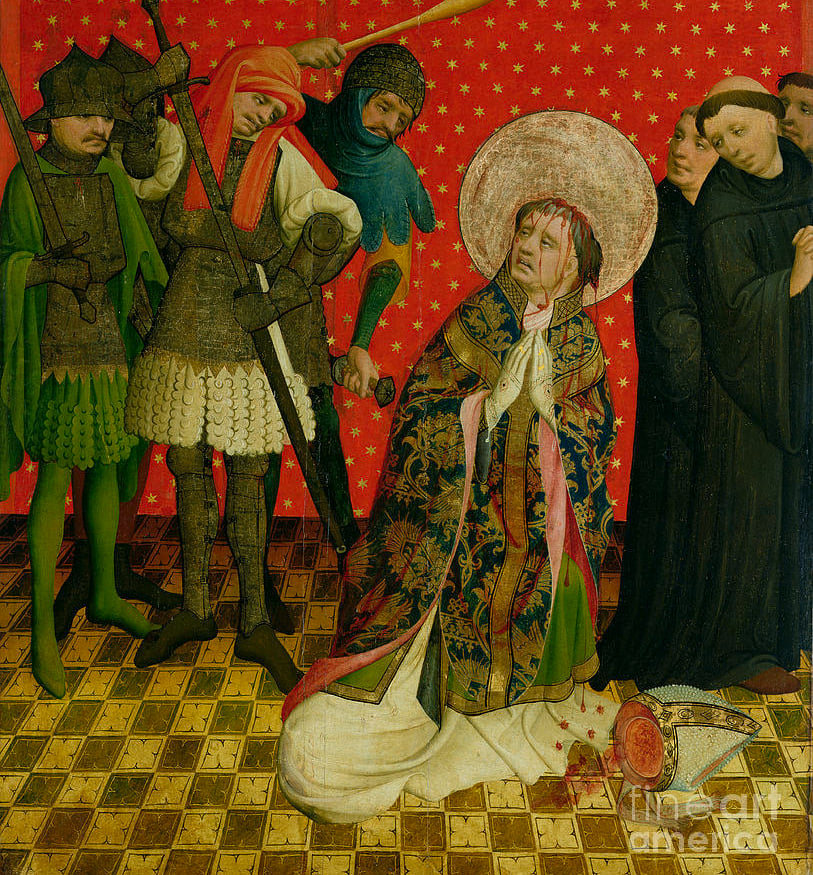
Accordingly, they stealthily enter Canterbury, and finding the Bishop was in the Church, officiating at Vespers, they began their attack.
The Clergy were using means to prevent them from entering the Church, when the Saint, coming to them, forbad their opposition, and, opening the door, thus spoke to them: The Church is not to be guarded like a citadel, and I am glad to die for God a Church,
Then turning to the soldiers, he said: I command you, in the name of God, that you hurt not any of them that are with me.
After this? he knelt down, and commending his Church and himself to God, to the Blessed Mary, to St. Denis, and to the other Patron Saints of his Cathedral, with the same courage that he had shown in resisting the King's execrable laws, he bowed down his head to the impious murderers, on the Fourth of the Calends of January (December 29th), in the Year of our Lord 1171.
His brains were scattered on the floor of the entire Church.
God having shown the holiness of his servant by many miracles, he was canonised by the same Pope, Alexander 3rd.
The Greatness of Bishops: Humility and Calling
When we meet, in the Annals of the Church, with the names of those great Bishops, who have been the glory of the Christian Pontificate, we are at once sure, that these men, the true images of the great High Priest Jesus our Lord, did not intrude themselves, uncalled, into the dread honours of the Sanctuary.
The history of their Lives shows us, that they were called by God himself, as Aaron was: and when we come to examine, how it was that they were so great—we soon find, that the source of their greatness was their humility, that led them to refuse the honourable burden, which others would put upon them.
God assisted them in the day of trouble and trial, because their exaltation to the episcopacy had been his own work.
St. Thomas Accepts the Burden
Thus was it with St. Thomas, who sat on his episcopal throne of Canterbury, the dignified and courageous Primate.
He began by declining the high honour that was offered him.
He boldly tells the King, (as St. Gregory the Seventh, before ascending the Papal Throne, told the Emperor who fain would see him Pope,) that, if forced to accept the proffered dignity, he is determined to oppose abuses.
He thought by this to frighten men from putting him into the honours and responsibilities of the Pastoral charge, and hoped that they would no longer wish him to be a Bishop, when they suspected that he would be a true one:—but, the decree of God had gone forth, and Thomas, called by God, was obliged to bow down his head, and receive the holy anointing.
And what a Bishop he, that begins by humility, and the determination to sacrifice his very life in the discharge of his duty!
He is worthy to follow, and that to Calvary, the God-Man, who, being called, by his Father, to Priesthood and to Sacrifice, enters this world, saying: Behold! I come to do thy will, O God!1
The Liturgy Applies Scripture to St. Thomas
The Gradual, in its first Versicle, applies to St. Thomas, the encomium given by the Sacred Scripture to Abraham.
These words, which speak the praises of one, who surpassed all others in merit, are singularly applicable to our illustrious Martyr, whose glory exceeds that of most other holy Bishops, whose memory is celebrated by the Church.
The Alleluia-Verse repeats the words of our Saviour, in which he declares himself to be the Good Shepherd.
Why does the Church use them on this Feast?
She would, thereby, tell us, that St. Thomas was a faithful representation of Him, whom St. Peter calls the Prince of Pastors.2
The Pastor Must Be Ready to Die
All the strength of the Pontiffs and Pastors of the Church consists in their imitation of Jesus.
It is not enough, that they have in them the character of his Priesthood; they must, also, be ready, like Him, to lay down their lives for their sheep.
The Shepherd who thinks more of his own life than of the salvation of his flock, is a hireling—he is not a shepherd: he loves himself, and not his sheep.
His flock has a claim upon his shedding his blood for them; and if he will not, he is no longer an image of the Good Shepherd, Jesus.
See how calmly St. Thomas lays down his life! He bows down his 'head to receive the blows of his executioners, as though he were simply acquitting himself of a duty, or paying a debt
After the example of Jesus, he gives his blood for the deliverance of his people; and no sooner has the sword done its work, than the Church, over which God had placed him, is set free: his blood has brought peace.1
He withstood the wolf, that threatened destruction to his flock; he vanquished him; the wolf himself was turned into a lamb, for the king visited the Tomb of his victim, and sought, in prostrate supplication, the Martyr's blessing.
The Shepherd Known by His Sheep
Thomas knew his sheep, that is, he loved them; it was a happiness to him, therefore, to die for them.
He was made Pastor, on the condition that he would die for them; just as our Emmanuel was made High Priest in order that he might offer Sacrifice, in which, too, he was both Priest and Victim.
Jesus' sheep know their divine Shepherd—they know that he came in order to save them; therefore is it, that his Birth at Bethlehem is so dear to them.
The Shepherd of Canterbury, too, is also known by his sheep; and, therefore, the Feast of his triumphant martyrdom is very dear to them, not only in the century when it happened, but even now, and so will it ever be, even to the end of time.
In return for this love and devotion, paid him by the Church on earth, Thomas blesses her from heaven.
We cannot doubt it—the wonderful return to the ancient Faith, which we are now witnessing in our dear England, is due, in no little measure, to the powerful intercession of St. Thomas of Canterbury; and this intercession is the return, made by our glorious Martyr, for that fervent and filial devotion, which is shown him, and which the faithful will ever show to him who was so heroically, what only the true Church can produce—a true Pastor.
The Crown of Glory
In the Offertory, the holy Church sings of the crown of glory, wherewith our Emmanuel encircled the brow of his Martyr.
The Pastor gave his blood to purchase that crown; and his death gave him life.
A Prayer to the Glorious Martyr
O glorious Martyr Thomas! courageous defender of the Church of thy divine Master! we come on this day of thy Feast, to do honour to the wonderful graces bestowed upon thee by God.
As children of the Church, we look with delighted admiration on him who so loved her, and to whom the honour of this Spouse of Christ was so dear, that he gladly sacrificed his life in order to secure her independence and Liberty.
Because thou didst so love the Church, as to sacrifice thy peace, thy temporal happiness, and thy very life, for her; because, too, thy sacrifice was for nothing of thine own, but for God alone;—therefore, have the tongues of sinners and cowards spoken ill of thee, and heaped calumnies upon thee.
O Martyr truly worthy of the name! for, the testimony thou didst render was against thine own interests.
O Pastor! who, after the example of Jesus the Good Shepherd, didst shed thy blood for the deliverance of thy flock! we venerate thee, because the enemies of the Church insulted thee; we love thee, because they hated thee; and we humbly ask thee to pardon them that have been ashamed of thee, and have wished that thy Martyrdom had never been written in the History of the Church, because they could not understand it!
The Honour of Bethlehem
How great is thy glory, O faithful Pontiff! in being chosen, together with Stephen, John, and the Innocents, to attend on the Infant Jesus in the stable of Bethlehem!
Thou didst enter on the battlefield at the eleventh hour; and far from being, on that account, deprived of the reward granted to the earliest of thy brother combatants, thou art great even amongst the Martyrs.
How dear must thou not be to the Divine Babe, whose Birth-Day we are keeping, and who came into the world that he might be the King of Martyrs!
What will he refuse to his grand Martyr of Canterbury?
Then, pray for us, and gain us admission into Bethlehem.
A Request for Fortitude and Fidelity
Our ambition is to love the Church, as thou didst—that dear Church, for love of which, Jesus has come down upon the earth—that sweet Church our Mother, who is now unfolding to us such heavenly consolations, by the celebration of the great Mysteries of Christmas, with which thy name is now inseparably associated.
Get us, by thy prayers, the grace of Fortitude, that so we may courageously go through any suffering, and make any sacrifice, rather than dishonour our proud title of Catholic.
Speak for Us to the Infant Jesus
Speak for us to the Infant Jesus—to Him that is to bear the Cross upon his shoulders, as the insignia of his government1—and tell him that we are resolved, by the assistance of his grace, never to be ashamed of his cause, or its defenders;
that, full of filial simple love for the Holy Church, which he has given us to be our Mother, we will ever put her interests above all others;
for, she alone has the words of eternal life, she alone has the power and the authority to lead men to that better world, which is our last end, and passes not away, as do the things of this world;
for, everything in this world is but vanity, illusion, and, more frequently than not, obstacles to the only real happiness of mankind.
Related Articles: Saints Page
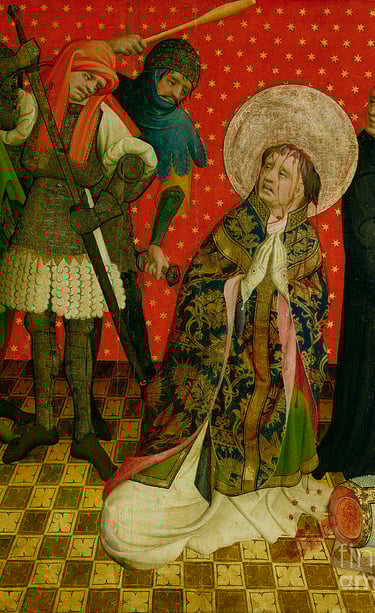
The Martyrdom Of St. Thomas Of Canterbury, 1424 (photo: Public Domain)
Contact
Phone
info@mostholytrinity.org
© 2026. All rights reserved.