
SAINT FABIAN, POPE AND MARTYR AND SAINT SEBASTIAN, MARTYR
Taken From THE LITURGICAL YEAR, Dom Guéranger OSB, | Christmas Vol 3
Two great Martyrs divide between them the honours of this twentieth day of January:—one, a Pontiff of the Church of Rome; the other, a member of that Mother-Church. Fabian received the crown of martyrdom in the year 250, under the persecution of Decius; the persecution of Diocletian crowned Sebastian in the year 288. We will consider the merits of these two champions of Christ separately.
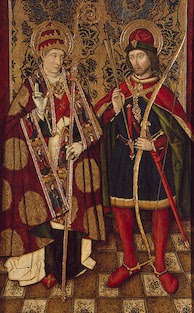
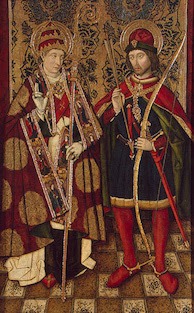
SAINT FABIAN
St. Fabian, like St. Clement and St. Antheros, two of his predecessors, was extremely zealous in seeing that the Acts of the Martyrs were carefully drawn up. This zeal was no doubt exercised by the clergy in the case of our holy Pontiff himself, and his sufferings and martyrdom were carefully registered; but all these interesting particulars have been lost. In common with an immense number of other precious Acts, which were condemned to the flames by the Imperial Edicts, during the persecution under Diocletian. Nothing is now known of the life of St. Fabian, save a few of his actions as Pope; but we may have some idea of his virtues, by the praise given him by St. Cyprian, who, in a letter written to St. Cornelius, the immediate successor of St. Fabian, calls him an incomparable man.
The Bishop of Carthage extols the purity and holiness of life of the holy Pontiff, who so peaceably governed the Church amidst all the storms which besailed her. There is an interesting circumstance related of him by Eusebius. After the death of St. Antheros, the people and clergy of Rome assembled together, for the election of the new Pontiff. Heaven marked out the successor of St. Peter: a dove was seen to rest on the venerable head of Fabian, and he was unanimously chosen. This reminds us of the event in our Lord’s Life, which we celebrated a few days back, when standing in the river Jordan, the Dove came down from heaven, and showed him to the people as the Son of God. Fabian was thus deposited the power of regeneration, which Jesus, by his Baptism, gave to the element of water; he zealously propagated the Faith of his Divine Master, and, among the Bishops he consecrated for distant places, one or more were sent by him into these western parts of Europe.
We give, at once, the short account of the Acts of St. Fabian, as recorded in the Liturgy.
Fabian, a Roman by birth, governed the Church from the reign of Maximin to that of Decius. He divided the City into seven parts, which he consigned to as many Deacons, and to them he charged of looking after the poor. He created also seven Subdeacons, who were to collect the Acts of the Martyrs, written by seven Notaries. It was he decreed, that, every year, on the feast of Easter, the Chrism should be renewed, and the old should be burnt.
At length, on the thirteenth of the Calends of February (January 20), he was crowned with martyrdom, in the year of Christ 250. He was buried in the cemetery of Callistus, on the Appian Way.
Fabian was ordained on the month of December, in which ordinations, he made two and twenty Priests, seven Deacons, and eleven Bishops for divers places.
Thus didst thou live out the long tempestuous days of thy Pontificate, O Fabian! But thou hadst the presentiment of the peaceful future reserved by God for his Church, and thou didst zealously labour to hand down to the coming generations the great example of the Martyrs. The flames have robbed us of a great portion of the treasures thou preparedst for us, and have deprived us of knowing the Fabian who so loved the Martyrs, and died one himself. But of thee, Blessed Pontiff, we know enough to make us thank God for having set thee over his Church in those hard times, and kept this day as a feast in celebration of thy glorious triumph. The dove, which marked thee out as the one chosen by heaven, showed thee that thou wast visibly Christ’s vicar; it told thee that thou wert destined for heavy responsibilities and martyrdom; it was a warning to the Church, and a consolation for her, during those trying times. Honour thou us with a resemblance to Jesus, who Jesus in the mystery of his Epiphany, pray to him for us, that the mercifully manifest himself to our mind and heart. Obtain of him, for us, that docility to his grace, that loving submissiveness to his every will, that detachment from all created things, which were the support of thy life, during those fifteen years of thy ever threatened and anxious pontificate.
When the angry persecution at length broke on thee, it found thee prepared, and martyrdom carried thee to the bosom of that God, who had already welcomed so many of thy martyred children. We, too, are looking for that last wave, which is to break over us, and carry us from the shore of this present life to eternity. Oh! pray for us, that it may find us ready! If the love of the Divine Babe, our Jesus, be within us; if, like thee, we imitate the simplicity of the dove;—we shall not lose it! Here our hearts—we wish for nothing but God—help us by thy prayers.
SAINT SEBASTIAN
At the head of her list of heroes, after the two glorious Apostles Peter and Paul, whom her chief glory—Rome—places first in rank, the Church of Rome venerates Saints Laurence and Sebastian, and her two most illustrious Virgins, Cecily and Agnes. Of these four, two are young in the court of the Infant Jesus at Bethlehem. Laurence and Cecily will come to us further on in our year, when either mysteries will be filling our hearts and the Liturgy; but Christmas calls forth Sebastian and Agnes. To-day, it is brave soldier of the Praetorian Band, Sebastian, who attends her Court of our Emmanuel; to-morrow, we shall see Agnes, gentle as a lamb, yet fearless as a lion, inviting us to love the sweet Babe, whom she chose for her only one Spouse.
The chivalrous spirit of Sebastian reminds us of the great Archdeacon; of both men one in the sanctuary, and the other in the world, defined the tortures of death. Burnt on one side, Laurence bids the tyrant roast the other; Sebastian, pierced with his arrows, waits till the gaping wounds are closed, and then runs to his persecutor Diocletian, asking for a second martyrdom. But, we must forget Laurence to-day, to think of Sebastian.
We must picture to ourselves a young soldier, who tears himself away from all the ties of his home at Milan, because the persecution there was too tame, whereas, at Rome, it was raging in wildest excess. He trembles with anxiety at the thought, that, perhaps, some of the Christians, in the Capital, may be losing courage. He has been told that, at times, some of the Emperor’s soldiers, who were also of Christ, have gained admission into the prisons, and have given strengthening courage of the confessors. He is resolved to go on the like mission, and, who knows? he may come within reach of a palm himself. He reaches Rome; he is admitted into the prisons, and encourages to martyrdom such as had been shaken by the terrors of those who were enduring the same. One of the miracles, became Martyrs themselves; and one of the Roman Magistrates asks to be instructed in a religion which can produce men such as Sebastian. He has won the esteem of the Emperors Diocletian and Maximian-Hercules for his fidelity and courage as a soldier; they have loaded him with favours; and this gives him an influence in Rome, which he so zealously turns to the advantage of the Christian religion, that the holy Pope Caius calls him the defender of the Church.
After sending innumerable martyrs to heaven, Sebastian, at length, wins the crown he had so ardently longed. He incurs the displeasure of Diocletian by confessing himself a Christian; the heavenly King, for whose sake alone he had put off the helmet and soldier’s cloak, was to him above all Emperors and Princes. He is handed over to the archers of Mauritania, who strip him, bind him, and wound him, from head to foot, with their arrows. They left him for dead, but a pious woman, named Irene, took care of him, and his wounds were healed. Sebastian again approaches the Emperor, who orders him to be beaten to death in the circus, near the Imperial Palace.
Such are the soldiers of our new-born King! but, oh! how richly does he repay them for their service! Rome, the Capital of his Church, is founded on seven Basilicas, as the ancient City was on its seven hills; and the name and tomb of Sebastian grace one of these seven sanctuaries. The Basilica of Sebastian stands in a sort of solitude, on the Appian Way, outside the walls of the Eternal City; it is enriched with the relics of the holy Pope and Martyr Fabian; but Sebastian, the valiant leader of the Praetorian guard, is the Patron, and, as it were, the Prince of the holy temple. It was here that he wished to be buried, as a faithful guardian, near the well wherein the bodies of the holy Apostles had been concealed, lest they should be desecrated by the persecutors.
In return for the zeal of St. Sebastian for the souls of his Christian brethren, whom he preserved from the contagion of paganism, God has made him the Protector of the Faithful against pestilence. A signal proof of this power granted to the holy Martyr, was given at Rome, in the year 680, under the Pontificate of St. Agatho.
Related Articles: Saints Page
Contact
Phone
info@mostholytrinity.org
© 2026. All rights reserved.