
SAINT AGNES, VIRGIN AND MARTYR
Taken From THE LITURGICAL YEAR, Dom Guéranger OSB, | Christmas Vol 3
How rich is the constellation of Martyrs, which shines in this portion of the sacred Cycle. Yesterday, we had St. Sebastian; tomorrow, we shall be singing the name which means Victory, for it is the Feast of Vincent; and now, today, between these two bright luminaries, we are rejoiced with the lovely rose and lily-wreath of Agnes. It is to a girl of thirteen that our Emmanuel gave this stern courage of soldierdom, which made her meet the angry rush as bold a front as either the valiant Captain of the Praetorian band or the dauntless Deacon of Saragossa.
If today and to-morrow’s gems, the glory bestowed and devoted Spouses. These are the triumphs of the Son of Mary! Scarcely has he shown himself to the world, and lo! every noble heart flies towards him, according to that word of his: Wheresoever the body shall be, there shall the eagles also be gathered together.
It is the admirable result of the Virginity of his Blessed Mother, who has brought honour to the fecundity of the soul, and set it far above that of the body. It was Mary that first opened the way, whereby certain chosen souls mount up even to the Divine Son, and fix their gaze, in a cloudless vision, on his beauty; for he himself said: Blessed are the clean of heart; for they shall see God.
What a glory is it not for the Catholic Church, that she alone has the gift of this holy state of Virginity, which is the source of every other sacrifice, because nothing but the love of God could inspire a human heart to vow Virginity! And what a grand honour for Christian Rome, that she should have produced a Saint Agnes, that angel of earth, in comparison with whom the Vestals of paganism are mere pretences of devotedness, for their Virginity was never purchased by fire and sword, nay, rather was flattered by the recompense of earthly honours and riches!
Not that our Saint is without her recompense—only, her recompense is not marred with the flaw of human reward. The name of this child, who lived but thirteen short years, will be echoed to the end of time, in the sacred Canon of the universal Sacrifice. The path trod by the innocent maiden, Holy way to her trials, is still marked out in the Holy City. In the Circus Agonalis, there rises the beautiful Church of Saint Agnes, with its rich cupola; and beneath are the vaults in which were once the baths of infamy, but now are a holy sanctuary, where everything reminds us of her who here won her glorious victory. Further on, on the Nomentan Road, outside the ramparts, is the beautiful Basilica, built by Constantine; and here, under an altar covered with precious stones, lies the Body of the young Saint. Around this Basilica, there are immense crypts; and in these did Agnes’ Relics repose until the epoch of peace, surrounded by thousands of Martyrs, whose holy remains were also deposited here.
Nor must we pass over in silence the gracious tribute of honour paid by Rome each year, on this Feast, to her beloved Martyr. Two lambs are placed on the altar of the Basilica Nomentana; they are emblems of the meekness of Jesus and the innocence of the gentle Agnes. After they have been blessed by the Abbot of the Religious Community, which serves this Church, they are taken to a Monastery of Nuns, where they are carefully reared. Their wool is used for making the Palliums, which the Pope sends to all Patriarchs and Metropolitans of the Catholic world, as the essential emblem of their jurisdiction. Thus, this simple woolen ornament, which these prelates have to wear on their shoulders, as a symbol of the sheep carried on the shoulders of the good Shepherd, reminds the Sovereign Pontiff, as well as the Altar which St. Peter in order to tend it to its destination, carries to their ends of the world the sublime precept of these two sentiments—the vigour and power of the Prince of the Apostles, and the gentleness of Agnes the Virgin.
We will now quote the beautiful eulogium of St. Agnes, written by St. Ambrose in his Book On Virgins. The Church gives almost entire passages in her Office of to-day’s Feast; and, assuredly, the Virgin of Christ could not have had a fairer panegyrist than the great Bishop of Milan, who is the most eloquent and persuasive of all the Fathers on the subject of holy Virginity. We read, that in the Cities, where Ambrose preached, Mothers were afraid of their daughters being present at his Sermons, lest he should persuade them to such love of Christ, as to choose the better part.
“Having resolved,” says the holy Bishop, “to write a Book on Virginity, I think myself happy in being able to begin it on the Feast we are keeping of the Virgin Agnes. It is the Feast of a Virgin; let us walk in the path of purity. It is the Feast of a Martyr; let us offer up our sacrifice. It is the Feast of St. Agnes; let men admire, and children not despair; let the married wonder, and the unmarried imitate. But what can we speak worthy of this Saint, who so very name is not void of praise? ‘As her devotedness is beyond her years, and her virtue superhuman—so, as it seems to me, her name is not an appellation, but a prophecy, presaging that she was to be a Martyr.’ The holy Doctor is here alluding to the word Agnus, from which some have derived the name Agnes; and he says, that the young Saint had in her very name, for it called her victory. ‘She goes on to consider the other etymology of Agnes, from the Greek word agnos, which means pure; and he thus continues his discourse:
“‘The maiden’s name is an expression of purity. ‘Martyr,’ then, and ‘Virgin,’ is not that praise enough? There is no praising eloquence, as merit is what so great a name proclaims. No question remains worthy, as he who may be praised by all. Nor are the praisers of Agnes, for when they pronounce her name, they say her praise, for they say ‘Agnes.’
“‘A Martyr.’ There is a tradition, that she suffered martyrdom at the age of thirteen. Detestable, indeed, the cruelty, that spared not even childhood; the power of faith, that could defy even children to be its witnesses! Here was a victim sacred before the age of a wound, for, where could the sword fall? and yet she had courage enough to conquer the sword.
“‘At such an age as this, a girl trembles if she but sees her mother angry, and cries, though it were a grievous thing, if but pricked with a needle’s point. And Agnes, who stands amidst blood-stained murderers, is fearless! She is stunned not with the rattle of the heavy chains, and yet not a flutter in that heart! She offers her whole body to the sword of” “the furious soldier, for though she knows not what death is, yet is she quite ready to endure it. Perchance, they will take her by force to the altars of their gods! If they do, she will stretch out her hands to Jesus, and, amidst those sacrilegious fires, she will sign herself with the blessed sign, the trophy of our divine conqueror; and then, if they will, and they can, find shackles small enough to fit such tender limbs, they may fasten her hands and neck in their irons, fetters!
“‘How strange is martyrdom! She is too young to be punished, yet she is old enough to win a victory. She cannot fight, yet she can easily gains a crown. She has but the age of a school-girl, yet has the masterful severity of virtue. Bride never went so nuptials with so glad a heart, or so light a step, as this virgin marches to the place of execution. She is decked, not with the gay show of plaited tresses, but with Christ; she wears, not with flowers, but with purity.
“‘All stood weeping; Agnes shed not a tear. Some wondered, how it could be, that she had but just begun her life, should be as ready to sacrifice it, as though she had lived it out; and every one was amazed, that she, who was so young to give evidence of her own affairs, should be so bold a witness of the divinity. Her oath would be invalid in a human cause; yet, she is believed, when she bears testimony for her God. Their surprise was just; for a power thus above nature could only come from Him, who is the author of all nature.
“‘Her executioner does all he can to frighten her; he speaks fair words to coax her; he tells her of all the suitors who have sought her as their bride; but she replies: ‘The Spouse insults her Beloved if she hesitate. I belong to Him who first betrothed me—why, executioner, dost thou not strike? Kill this body, which might be loved by eyes I would not should please.’
“She stood, she prayed, she bowed down her head. The executioner trembles, as though himself were going to be beheaded. His hand shakes, and his cheek grows pale, to strike this girl, who loves the danger and the blow. Here, then, have we twofold martyrdom in a single victim—one for her chastity, the other for her faith. She was a Virgin before; and now, she is a Martyr.”
The Roman Church sings, on this Feast, the sweet Responsories, in which Agnes expresses her tender love of her Jesus, and her happiness at having Him for her Spouse. They are formed from the words of the ancient Acts of the Martyrdom, which were long attributed to the pen of St. Ambrose.
RESPONSORIES
Rᵥ. My Spouse has set precious stones on my right hand, and has hung priceless jewels around my neck; he has placed on me a splendid garment, and I have none other to love but Him.
Rᵥ. I love Christ; I shall be the spouse of Him, whose Mother is a Virgin, and whose Father begot Him divine; and I am chaste; when I love Him.
Related Articles: Saints Page
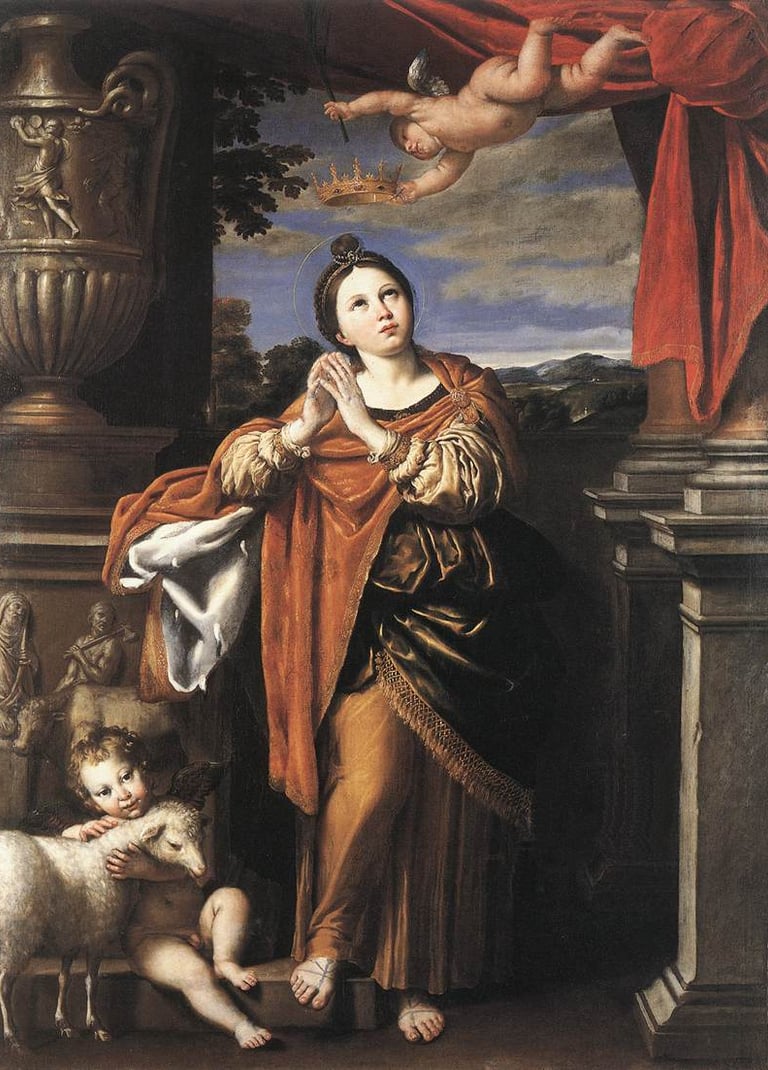
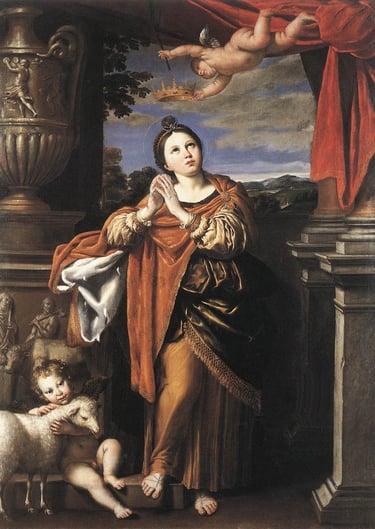
Saint Agnes by Domenichino (c. 1620)
Contact
Phone
info@mostholytrinity.org
© 2026. All rights reserved.