
On Mary's Immaculate Conception DISCOURSE II
Taken from THE MOTHER OF THE SAVIOR With Imprimatur, Imprimi Potest, and Nihil Obstat TAN Books and Publishers
MARIAN
Fr. Reginald Garrigou-Lagrange, 1948
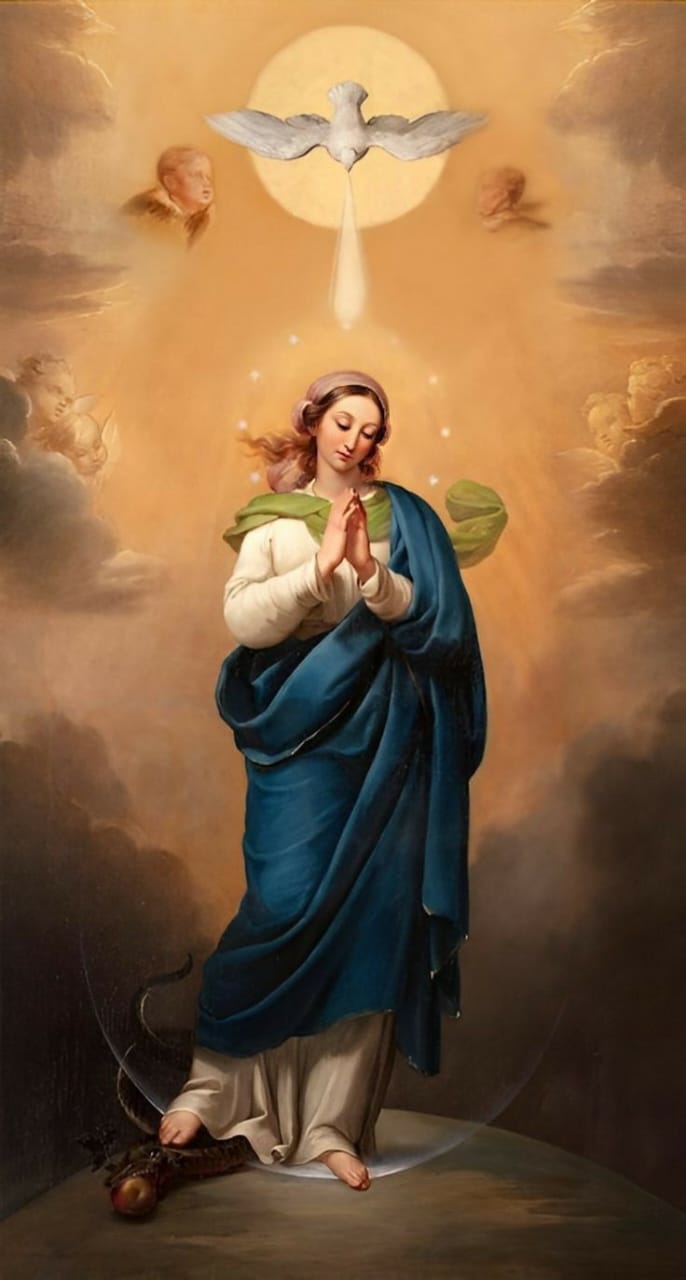
Hail, full of Grace
------Luke 1: 28
[Because of] the nobility of Mary's title, Mother of God, it is . . . appropriate to examine the meaning and implications of the words spoken to her by the Angel Gabriel on the day of the Annunciation: 'Hail, full of grace, the Lord is with thee: Blessed art thou among women' (Luke 1: 28). As a help to understanding these words spoken in God's name we shall consider: 1st-----the different plenitudes of grace; 2nd-----the privilege of the Immaculate Conception; 3rd-----the sublimity of Mary's first grace.
Article I
THE DIFFERENT PLENITUDES OF GRACE
According to the usage of Holy Scripture, which becomes more and more explicit in the New Testament, it is grace in the strict sense of the term which is implied in the term 'fulness of grace'-----that is to say, grace which is really distinct from nature, both human and Angelic, grace which is a free gift of God surpassing the natural powers and exigencies of all nature, created or creatable. [l] Habitual or sanctifying grace makes us participate in the very nature, in the inner life of God, according to the words of St. Peter (2 Peter 1: 4): 'By whom he hath given us most great and precious promises: that by these you may be made partakers of the divine nature.' By grace we have become adopted children of God, heirs and co-heirs with Christ (Rom. 8: 17); by grace we are 'born of God' (John i, 13). It prepares us to receive eternal life as a heritage and as a reward of the merits of which it is itself the principle. It is even the germ of eternal life, the semen gloriae as Tradition terms it, since by it we are disposed in advance for the face to face vision and the beatific love of God.
Habitual grace is received into the very essence of the soul as a supernatural graft which elevates and deifies its vitality. From it there flows into the faculties the infused virtues, theological and moral, and the seven gifts of the Holy Ghost, all of which supernatural organism constitutes a sort of second nature of such a kind as to enable us to perform connaturally the supernatural and meritorious acts of the infused virtues and the seven gifts. We have, too, by habitual grace the Blessed Trinity dwelling within us as in a temple where They are known and loved, even as it were experimentally. And at times we do know Them in this quasi-experimental fashion when by a special grace They make Themselves known to us as the life of our life, for '. . . you have received the spirit of adoption of sons, whereby we cry Abba [Father]' (Rom. 8: 15). Then does the Holy Ghost inspire us with filial love, and in that sense '. . . the Spirit Himself giveth testimony to our spirit, that we are the sons of God' (Rom. 8: 16).
While habitual grace makes us thus children of God, actual or transitory grace first of all disposes us for adoptive childhood, and subsequently makes us act, through the infused virtues and gifts working separately or both together, in a manner becoming God's children. This new life of grace, virtues and gifts, is none other than eternal life begun on earth, since habitual grace and charity will outlive the passage of time.
Grace-----call it, if you will, a participation in the Divine nature-----was no less gratuitous for the Angels than for us. As St. Augustine says (De Civ. Dei, XII, c. 9): 'God created them, at the same instant forming their nature and endowing them with grace.' When creating the Angels God conferred grace on them, to which grace their nature, richly endowed though it was, could lay no claim. The Angels, and man also, could have been created in a purely natural condition, lacking the Divine graft whence issues a new life.
The grace intended in the words 'Hail, full of grace' addressed to Our Lady is therefore something higher than nature or the exigencies of nature, created or merely possible. It is a participation in the Divine nature or in the inner life of God, which makes the soul to enter into the kingdom of God, a kingdom far surpassing all the kingdoms of nature-----mineral, vegetable, animal, human, and even Angelic. So elevated is grace that St. Thomas could say: 'The good of the grace of one soul is greater than the good of the nature of the whole universe.' [2] The least degree of grace in the soul of a newly Baptized child is worth more than all created natures, including those that are Angelic. Being a participation in the inner life of God, grace is something greater than all miracles and exterior signs of Divine revelation or of the sanctity of God's favoured servants. And it is of this grace, germ and promise of glory, that the Angel spoke when he said to Mary: 'Hail, full of grace.' Gazing at Mary's soul, he saw that, though he himself was in the possession of the Beatific Vision, Mary's grace and charity far surpassed his for she possessed them in the degree required to become at that instant the Mother of God.
Mary, of course, had received from the Most High natural gifts of body and soul in wonderful perfection. Judged even from the natural level, the soul of Jesus united in itself all that there is of beauty and nobility in the souls of the great poets and artists, of men of genius and of men of generosity. In an analogous way the soul of Mary was a Divine masterpiece because of the natural perfection of her intelligence and will and sensibility. There is no shadow of doubt that she was more gifted than anyone who has ever struck us as remarkable for penetration and sureness of mind, for strength of will, for equilibrium or harmony of higher and lower faculties. Since she had been preserved from Original Sin and its baneful effects, concupiscence and darkness of understanding, her body did not weigh down her mind but rather served it. When forming the body of a Saint, God has in mind the soul which is to vivify it: when forming Mary's body He had in mind the Body and the infinitely holy Soul of the Word made flesh. As St. Albert the Great loves to recall, the Fathers of the Church say that Mary, viewed even naturally, had the grace of Rebecca, the beauty of Rachel, and the gentle majesty of Esther. They add that her chaste beauty never held the gaze for its own sake alone, but always lifted souls up to God.
The more perfect these gifts of nature in Mary, the more elevated they make her grace appear, for it surpasses them immeasurably.
When speaking of fulness of grace it is well to note that it exists in three different degrees in Our Lord, in Mary, and in the just. St. Thomas explains this a number of times. [3]
There is, first of all, the absolute fulness of grace which is peculiar to Jesus, the Saviour of mankind. Taking into consideration only the ordinary power of God, there can be no greater grace than this. It is the eminent and inexhaustible source of all the grace which all men have received since the Fall, or will receive till the end of time. It is the source also of the beatitude of the elect, for Jesus has merited all the effects of our predestination. [4]
There is, in the second place, the fulness of superabundance which is Mary's special privilege, and which is so named since it is like a spiritual river which has poured of its abundance upon the souls of men for almost two thousand years.
There is finally the fullness of sufficiency which is common to all the just and which makes them capable of performing those meritorious acts-----they normally become more perfect in the course of years-----which lead them to eternal life.
These three fullness have been well compared to an inexhaustible spring, to the stream or river which flows from it, and to the different canals fed by the river, which irrigate and make fertile the whole region they traverse-----that is to say, the whole Church, universal in time and space. The river of grace proceeds from God through the Saviour, as we read 'Drop down dew, ye heavens, from above, and let the clouds rain the just: let the earth be opened, and bud forth a saviour' (Is. 14: 8). And then finally it rises once more to God, the Ocean of peace, in the form of merits, prayers, and sacrifices.
To continue the image: the fulness of the spring has not increased; that of the river, on the contrary, which flows from it has increased. Or, to speak in plain terms, the absolute fulness of Our Saviour knew no increase, for it was sovereignly perfect from the first instant of His conception by reason of the personal union with the Word. For, from the first instant, the lumen gloriae and the Beatific Vision were communicated to Jesus's soul, so that the second Council of Constantinople could say (Denz. 224) that Christ did not grow more perfect by reason of His meritorious acts: 'Ex profectu operum non melioratus est.' Mary's fulness of grace, however, did not cease to increase up to the time of her death. For that reason theologians usually speak of, 1st-----her initial fullness or plenitude; 2nd-----the fulness of her second sanctification at the instant of the conception of the Saviour; 3rd-----the final fulness [at the instant of her entry into glory], its extent, and its superabundance. [5]
Article II
THE PRIVILEGE OF THE IMMACULATE CONCEPTION
The initial fulness of grace in Mary presents two aspects. One is negative, at least in its formulation: her preservation from Original Sin. The other is positive: her conception, absolutely pure and holy by reason of the perfection of her initial sanctifying grace in which were rooted the infused virtues and the gifts of the Holy Ghost.
The Dogmatic Definition
The definition of the dogma of the Immaculate Conception, made by Pius IX on December 8th, 1854, reads as follows: 'We declare, announce, and define that the doctrine which states that the Blessed Virgin Mary was preserved, in the first instant of her conception, by a singular grace and privilege of God Omnipotent and because of the merits of Jesus Christ the Saviour of the human race, free from all stain of Original Sin, is revealed by God and must therefore be believed firmly and with constancy by all the faithful' (Denz. 1641).
This definition contains three especially important points: 1st-----It affirms that the Blessed Virgin was preserved from all stain of Original Sin from the first instant of her conception. The conception meant is that known as passive or consummated-----that in which her soul was created and united to her body-----for it is then only that one can speak of a human person, whereas the definition bears on a privilege granted to the person of Mary. The definition states also that the Immaculate Conception is a special privilege and an altogether singular grace, the work of Divine Omnipotence.
What are we to understand by Original Sin from which Mary has been preserved? The Church has not defined its intrinsic nature, but she has taught us something about it by telling us its effects: the Divine hatred or malediction, a stain on the soul, a state of non-justice or spiritual death, servitude under the empire of Satan, subjection to the law of concupiscence, subjection to suffering and to bodily death in so far as they are the penalty of the common sin. [6] These effects presuppose the loss of the sanctifying grace which, along with integrity of nature, Adam had received for us and for himself, and which he lost by sin, also for us and for himself. [7]
It follows therefore that Mary was not preserved free from every stain of Original Sin otherwise than by receiving sanctifying grace into her soul from the first instant of her conception. Thus she was conceived in that state of justice and holiness which is the effect of the Divine friendship as opposed to the Divine malediction, and in consequence she was withdrawn from the slavery of the devil and subjection to the law of concupiscence. She was withdrawn too from subjection to the law of suffering and death, considered as penalties of the sin of our nature, [8] even though both Jesus and Mary knew suffering and death in so far as they are consequences of our nature [in carne passibili] and endured them for our salvation.
2nd-----It is affirmed in the definition, as it was already affirmed in 1661 by Alexander VIII (Denz. 1100) that it was through the merits of Jesus Christ, the Saviour of the human race, that Mary was preserved from Original Sin. Hence the opinion held by some 13th-century theologians-----that Mary was immaculate in the sense of not needing to be redeemed, and that her first grace was independent of the future merits of her Son-----may no longer be admitted. According to the Bull Ineffabilis Deus, Mary was redeemed by the merits of her Son in a most perfect way, by a redemption which did not free her from a stain already contracted, but which preserved her from contracting one. Even in human affairs we look on one as more a saviour if he wards off a blow than if he merely heals the wound it inflicts.
The idea of a preservative redemption reminds us that Mary, being a child of Adam and proceeding from him by way of natural generation, should have incurred the hereditary taint, and would have incurred it in fact had not God decided from all eternity to grant her the unique privilege of an immaculate conception in dependence on the future merits of her Son.
The liturgy had already made this point in the prayer proper to the Feast of the Immaculate Conception, which was approved by Sixtus IV (1476): 'Thou hast preserved her [Mary] from all stain through the foreseen death of this same Son.' The Blessed Virgin was preserved from Original Sin by the future death of her Son, that is to say, by the merits of Christ dying for us on the Cross.
It is therefore clear that Mary's preservation from Original Sin differs essentially from that of the Saviour. Jesus was not redeemed by the merits of another, not even by His Own. He was preserved from Original Sin and from all sin for two reasons: first because of the personal or hypostatic union of His humanity to the Word in the very instant in which His sacred soul was created, since it could not be that sin should ever be attributed to the Word made flesh; secondly, since His conception was virginal and due to the operation of the Holy Ghost, so that Jesus did not descend from Adam by way of natural generation. [9]
These two reasons are peculiar to Jesus alone.
3rd-----The definition proposes the doctrine of the Immaculate Conception as revealed, that is, as contained at least implicitly in the deposit of Revelation-----in Scripture and Tradition, or in one at least of those two sources.
The Testimony of the Scriptures
The Bull Ineffabilis Deus quotes two texts of Scripture, Genesis 3: 15, and Luke 1: 28, 42.
The privilege of the Immaculate Conception is revealed as it were implicitly or confusedly in the book of Genesis in the words spoken by God to the serpent, and thereby to Satan: 'I will put enmities between thee and the woman, and thy seed and her seed: she shall crush thy head and thou shalt lie in wait for her heel.' The pronoun we translate as 'she' in 'she shall crush thy head' is masculine in the Hebrew text, and stands for the posterity or seed of the woman; this is true also of the Septuagint and the Syraic versions. The Vulgate however has the feminine pronoun 'ipsa', referring the prophecy directly to the woman herself However there is no essential difference of meaning between the two readings since the woman is to be associated with the victory of Him Who will be the great representative of her posterity in their conflict with Satan throughout the ages.
Taken by themselves these words are certainly not sufficient to prove that the Immaculate Conception is revealed. But the Fathers of the Church, in their comparison of Eve and Mary, have seen in them an allusion to it, and it is on that account that the text is cited by Pius IX.
To the naturalist exegete the text means no more than the instinctive revulsion man experiences towards the serpent. But to the Jewish and Christian tradition it means much more. The Christian tradition sees in that promise-----it has been termed the protoevangelium-----the first sketch of the Messiah and His victory over the spirit of evil. For Jesus is pre-eminently the posterity of the woman in conflict with the posterity of the serpent. But if Jesus is termed the posterity of the woman, that is not because of His remote connection with Eve, who was able to pass on to her descendants only a fallen and wounded nature, deprived of the Divine life. Rather is it because of His connection with Mary, in whose womb He took a stainless humanity. As Fr. F. X. Le Bachelet says, in col. 118 of the article referred to already, 'We do not find in Eve the principle of that enmity which God will put between the race of the woman and the race of the serpent; for Eve, like Adam, is herself fallen a victim to the serpent. It is only between Mary, Mother of the Redeemer, that enmity ultimately exists. Hence the person of Mary is included, though in a veiled manner, in the protoevangelium, and the Vulgate reading 'ipsa' [she] expresses something really implied in the sacred text, since the victory of the Redeemer is morally, but really, the victory of His Mother.'
For that reason early Christianity never ceased to contrast Eve who shared in Adam's sin by yielding to the serpent's suggestion with Mary who shared in the redemptive work of Christ by believing the words of the Angel on the morning of the Annunciation. [10]
The promise of Genesis speaks of a victory that will be complete: 'She shall crush thy head.' And since the victory over Satan will be complete, so also the victory over sin which makes the soul slave and the devil master. But as Pius IX teaches in the Bull Ineffabilis Deus, the victory over Satan would not be complete if Mary had not been preserved from Original Sin by the merits of her Son: 'De ipso (serpente) plenissime triumphans, illius caput immaculato pede (Maria) contrivit.'
The Immaculate Conception is contained therefore in the promise of Genesis as the oak is contained in the acorn. A person who had never seen an oak could never guess the value of the acorn, nor its final stage of development. But we who have seen the oak know for what the acorn is destined, and that it does not yield an elm nor a poplar. The same law of evolution obtains in the order of progressive Divine revelation.
The Bull Ineffabilis quotes also the salutation addressed by the Angel to Mary (Luke 1: 28): 'Hail, full of grace . . . blessed are thou among woman', as well as the similar words uttered by St. Elizabeth under Divine inspiration (Luke 1: 42). Pius IX does not state that these words are sufficient by themselves to prove that the Immaculate Conception is revealed; for that, the exegetic tradition of the Fathers must be invoked.
This tradition becomes explicit with St. Ephrem the Syrian (d. 373). [11] Among the Greeks it is found on the morrow of the Council of Ephesus (431), especially in the teaching of two bishop-opponents of Nestorious, St. Proclus who was a successor of St. John Chrysostom in the chair of Constantinople (431-446) and Theodore, bishop of Ancyra. Later we find it in the teaching of St. Sophronius, Patriarch of Jerusalem (634-638), Andrew of Crete (d. 740), St. John Damascene [d. towards the middle of the 8th century]. These different testimonies will be found at length in the article Marie of the Dict. Apol., cols. 223-231.
Contact
Phone
info@mostholytrinity.org
© 2026. All rights reserved.